TL;DR:
- Anti-cut mesh offers significantly higher resistance to cutting tools due to its heavier gauge wire and smaller apertures. It provides strong physical deterrence and durability, especially in high-risk environments like industrial sites in South Africa. Proper installation and integration with surveillance systems are essential for maximizing its security effectiveness.
Not all mesh fencing offers the same level of protection, and assuming otherwise is a costly mistake many property owners make. Standard mesh panels can be cut through with bolt cutters or angle grinders in seconds, leaving high-risk sites completely exposed. Anti-cut mesh technology changes this equation fundamentally, introducing material composition and structural design features that resist cutting tools and slow down or stop would-be intruders. This guide explains how anti-cut mesh works, what advantages it provides over standard alternatives, and how South African property owners and facility managers can select and implement it effectively.
Table of Contents
- What is anti-cut mesh and how does it work?
- Key advantages of anti-cut mesh for property security
- Comparison: Anti-cut mesh vs. standard mesh fencing
- Selecting and installing anti-cut mesh fencing: Practical guide
- A smarter security strategy: Lessons from South African properties
- Get expert advice and top anti-cut mesh solutions
- Frequently asked questions
Key Takeaways
| Point | Details |
|---|---|
| Superior cutting resistance | Anti-cut mesh is engineered to withstand hand tools and deter intruders through robust material composition. |
| Enhanced property security | Facilities using anti-cut mesh experience fewer breaches and lower theft rates compared to standard fences. |
| Long-term durability | Quality anti-cut mesh requires less maintenance and remains effective in harsh environmental conditions. |
| Easy integration with security systems | Anti-cut mesh can be installed alongside cameras and access controls for comprehensive protection. |
What is anti-cut mesh and how does it work?
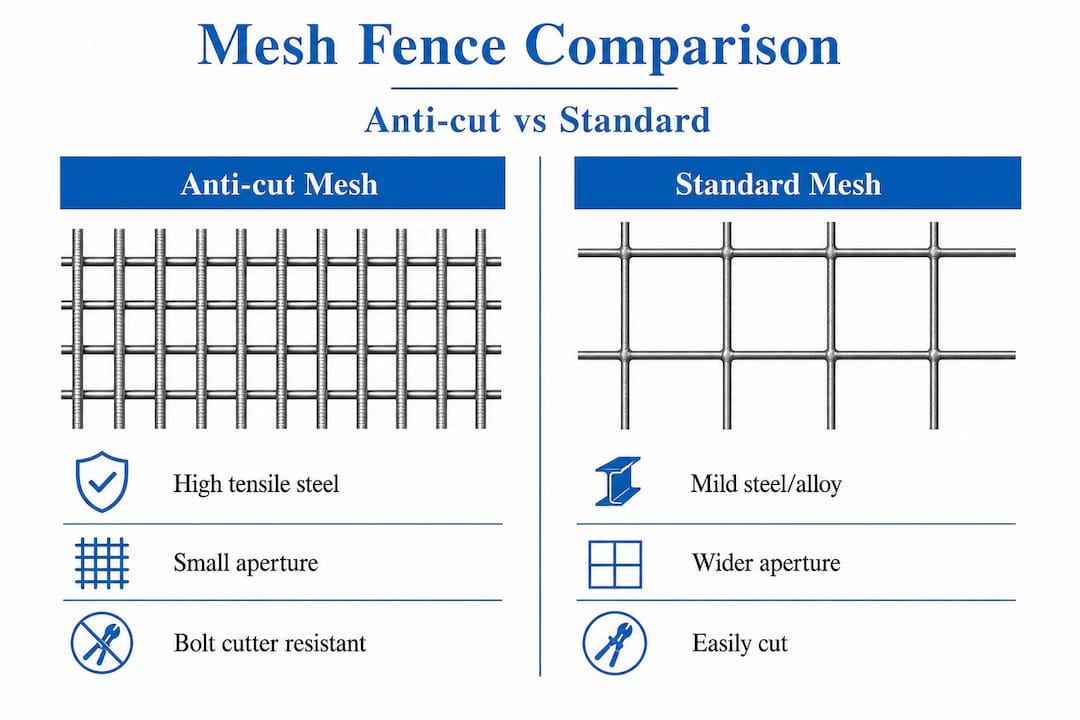
Anti-cut mesh is a high-security fencing material engineered specifically to resist forced entry using hand-held cutting tools such as bolt cutters, wire cutters, and angle grinders. Unlike standard mesh fencing, which uses relatively thin wire gauges and large apertures (the individual openings within the mesh panel), anti-cut mesh is manufactured with significantly heavier steel wire and tightly configured aperture dimensions that make cutting both difficult and time-consuming.
Understanding the basics of mesh fencing is helpful here. Standard mesh relies on intersecting wires welded or woven together, but those wires are typically thin enough for cutting tools to pass through with minimal effort. Anti-cut mesh fundamentally changes the material specification. The steel wire used is high-tensile grade, meaning it has a much higher resistance to deformation and shearing force. The wire is also heavily galvanized or coated with polyester powder for weather resistance, making it suitable for South Africa’s varied climate conditions from the Highveld heat to coastal humidity.
Anti-cut mesh resists cutting tools due to its unique composition and structure, including the way apertures are sized to prevent the insertion of cutting tool jaws. When the openings in a mesh panel are too small for a bolt cutter’s blades to fit through and grip a wire, the entire mechanical advantage of that cutting tool is neutralized. This is the core principle behind anti-cut design.
Key design features that define anti-cut mesh include:
- Wire gauge: Typically 4mm to 6mm diameter high-tensile steel wire, compared to 2mm to 3mm in standard mesh
- Aperture size: Commonly 12.5mm x 75mm or smaller, restricting tool access significantly
- Welded intersections: Each junction is electrically welded rather than simply twisted, creating rigid panel integrity
- Surface coating: Heavy galvanizing combined with polyester powder coating resists corrosion and tool grip
- Panel rigidity: Stiff panels that do not flex significantly under pressure, reducing opportunities for leverage
Exploring anti-climb designs overview alongside anti-cut specifications gives property managers a clearer picture of how modern security fencing addresses multiple attack vectors simultaneously.
Pro Tip: When evaluating any anti-cut mesh product, pay close attention to aperture size. A smaller aperture directly increases resistance to cutting tools because standard bolt cutter jaws cannot be positioned around individual wires. Aim for apertures of 12.5mm x 75mm or less for credible anti-cut performance.
Key advantages of anti-cut mesh for property security
With the technical foundation clear, the practical security advantages of anti-cut mesh become straightforward to appreciate. Property owners and facility managers in South Africa are faced with real and persistent threats including opportunistic theft, organised criminal operations, and vandalism. Anti-cut mesh directly addresses each of these scenarios.
Anti-cut mesh is used specifically to secure equipment and materials at construction locations, as well as industrial yards, warehouses, utility installations, and commercial perimeters where conventional fencing would be easily defeated. The advantages are both physical and psychological.
Physical advantages:
- Breach resistance: Heavy gauge wire and small apertures mean cutting tools are ineffective within any practical timeframe at an exposed site
- Structural durability: High-tensile steel with quality coatings withstands harsh South African weather, UV exposure, and temperature fluctuations without significant degradation
- Low maintenance requirement: Robust materials reduce the frequency and cost of repair or replacement compared to standard mesh panels
- Longevity: When properly installed and maintained, quality anti-cut mesh systems outlast conventional fencing by several years
Psychological and deterrence advantages:
- Visual deterrence: The visible robustness of anti-cut mesh signals to intruders that a property is actively secured, raising the psychological barrier to attempted entry
- Reduced opportunistic crime: Most opportunistic criminals rely on quick, low-effort entry methods; anti-cut mesh eliminates those quick methods entirely
Understanding the full range of types of mesh fencing helps property managers position anti-cut mesh correctly within a broader fencing strategy. It is not the right product for every perimeter section, but for high-risk areas, it is significantly superior to standard alternatives. Similarly, reviewing anti-climb fence benefits alongside anti-cut specifications allows for a more complete perimeter security plan.
Effective property management risk reduction consistently identifies perimeter integrity as a primary factor in minimising exposure to theft and liability. Facilities using anti-cut mesh report significantly fewer attempted entry incidents compared to those relying on standard mesh alternatives.
| Security factor | Anti-cut mesh | Standard mesh |
|---|---|---|
| Resistance to bolt cutters | High | Low |
| Wire gauge | 4mm to 6mm | 2mm to 3mm |
| Typical lifespan | 15 to 25 years | 8 to 12 years |
| Maintenance frequency | Low | Moderate to high |
| Deterrence visibility | Strong | Moderate |
| Aperture size | 12.5mm x 75mm or less | 50mm x 50mm or larger |
| Suitability for high-risk sites | Excellent | Poor |
Pro Tip: Pairing anti-cut mesh with monitored access points such as CCTV surveillance and electronic access control creates a layered defence system that significantly multiplies the security value of the mesh itself.
Comparison: Anti-cut mesh vs. standard mesh fencing
To make an informed decision, property owners need to understand precisely where anti-cut mesh differs from standard mesh options not just in terms of materials, but in real-world performance and long-term cost implications.
“Standard mesh fencing is vulnerable to cutting, making it less effective for high-security applications where perimeter integrity must be maintained under pressure from forced entry attempts.”
This distinction becomes critical when assessing which fencing solution is appropriate for a specific site. A residential garden boundary has very different requirements from an industrial compound, a substation perimeter, or a construction site storing heavy equipment overnight.
Understanding mesh aperture in security fencing is one of the most important starting points, since aperture size determines which tools can and cannot be used against a panel. Reviewing a welded mesh fencing overview also clarifies structural differences between welded and woven options, which directly affects panel rigidity and cut resistance.
Step-by-step process for assessing which mesh is right for your site:
- Define the threat level. Identify the specific risks your property faces, including opportunistic theft, organised criminal activity, vandalism, or unauthorised access by individuals without tools.
- Audit the perimeter. Walk the boundary and identify zones of varying risk: high-traffic public-facing sections versus concealed rear perimeters where forced entry is more likely to occur undetected.
- Review existing fencing condition. Determine whether current standard mesh shows signs of prior cutting attempts, rust-related weakness, or structural compromise.
- Match aperture and gauge to the threat. For any zone rated high or critical risk, specify anti-cut mesh with apertures of 12.5mm x 75mm or smaller and wire gauge of at least 4mm.
- Consider integration requirements. Evaluate whether the chosen mesh can be installed with existing posts and foundations, or whether a full system replacement is required.
- Obtain professional assessment. A certified fencing installer should verify your specifications against local conditions, soil type, and any relevant regulatory requirements before procurement.
| Characteristic | Anti-cut mesh | Standard mesh |
|---|---|---|
| Primary material | High-tensile galvanized steel | Mild steel wire |
| Aperture configuration | Small and restrictive | Large and open |
| Cutting tool resistance | Engineered resistance | No specific resistance |
| Typical application | Industrial, high-security, commercial | Residential, low-risk perimeters |
| Corrosion protection | Heavy galvanized plus powder coat | Light galvanizing only |
| Post-installation security level | High | Low to moderate |
Selecting and installing anti-cut mesh fencing: Practical guide
Selecting the correct anti-cut mesh product and ensuring it is properly installed are equally important steps. Even the highest-specification mesh will underperform if it is installed with inadequate post spacing, insufficient foundation depth, or without proper tensioning.
For South African property owners and managers, the following structured approach helps ensure that anti-cut mesh delivers its full security potential from the moment it is commissioned.
- Assess your security classification. Determine whether your site requires a Class A (perimeter only) or Class B (critical asset protection) standard, which will dictate minimum wire gauge and aperture requirements.
- Specify steel quality. Insist on high-tensile wire with a minimum tensile strength of 1000 MPa (megapascals, a measure of how much force the wire can withstand before breaking). Lower-grade steel is easier to cut and will not provide genuine anti-cut performance.
- Evaluate coating requirements. In coastal or high-humidity regions of South Africa, specify both hot-dip galvanizing and an additional polyester powder coat. This dual-layer protection extends the service life of the mesh considerably.
- Plan post spacing carefully. Anti-cut mesh panels are heavy and rigid. Post spacing should be calculated to avoid panel flex, which can create leverage points that compromise cut resistance.
- Integrate with existing systems. Consider whether your anti-cut mesh perimeter will incorporate pedestrian gates, vehicle access gates, or roller barriers. Reviewing an industrial fencing guide provides specific guidance for high-risk facility configurations.
- Plan the project timeline. A structured fencing project management guide ensures that procurement, site preparation, installation, and inspection phases are coordinated efficiently, avoiding costly delays or rework.
- Commission a post-installation inspection. Once installed, have an independent assessment carried out to confirm that all panels, posts, and integration points meet the specified security standard.
Professional installation ensures maximum security from day one, as improper installation techniques can introduce weaknesses that undermine even the most robust mesh specification. Certified installers understand torque requirements for fixings, correct concrete mix specifications for post foundations, and proper tensioning procedures.
Supporting municipal property security frameworks increasingly require that fencing at public and commercial facilities meet minimum anti-cut standards, particularly around utility infrastructure and public safety zones.
Pre-installation checklist:
- Wire gauge confirmed at 4mm minimum
- Aperture size at 12.5mm x 75mm or smaller
- Steel specification documented and verified
- Coating system appropriate for local climate conditions
- Post foundation depth and concrete specification confirmed
- Installer certification and previous project references reviewed
- Integration with access control and surveillance planned
Pro Tip: Always use certified and experienced installers for anti-cut mesh projects. Incorrect post installation depth, improper tensioning, or poorly secured panel fixings can create vulnerabilities that skilled intruders will quickly identify and exploit.
A smarter security strategy: Lessons from South African properties
There is a persistent and understandable assumption among property owners that installing anti-cut mesh resolves their perimeter security concerns entirely. In practice, that assumption regularly leads to disappointment. Anti-cut mesh is a highly effective physical barrier, but no single security measure operates effectively in isolation.
Properties across South Africa, particularly in Gauteng’s industrial corridors and commercial zones, have demonstrated a consistent pattern: perimeters protected by anti-cut mesh alone have still been breached, not by cutting through the mesh, but by exploiting adjacent weaknesses. Criminals who cannot cut through a panel will focus their efforts on poorly secured gates, unmonitored corners, inadequate lighting zones, or sections where the mesh meets a wall or building structure.
The lesson drawn from these incidents is clear. Anti-cut mesh forms the foundation of a perimeter security system, but it must be supported by CCTV surveillance positioned to eliminate blind spots, monitored alarm systems that respond to vibration or proximity, controlled access points with electronic verification, adequate perimeter lighting that removes cover of darkness, and regular physical inspections that identify and address any damage or installation degradation quickly.
Comprehensive anti-cut security planning integrates the mesh specification with these complementary systems from the outset, rather than treating the fencing as a standalone solution. Properties that adopt this layered approach consistently report stronger security outcomes and fewer successful intrusion events than those that rely on any single measure, regardless of how robust that measure is.
The practical wisdom here is straightforward: invest in the best anti-cut mesh specification your budget and site conditions justify, but allocate resources simultaneously to the complementary systems that make it genuinely effective.
Get expert advice and top anti-cut mesh solutions
Ready to protect your property with reliable anti-cut mesh solutions tailored to your specific risk profile? Jumalu Fencing specialises in the manufacturing, supply, and professional installation of high-security mesh fencing systems across South Africa, with deep experience in matching the right product specifications to the demands of industrial, commercial, and residential perimeters.
Our team works with property owners and facility managers to assess site-specific threats, specify the correct mesh aperture, wire gauge, and coating system, and deliver installations that meet or exceed security requirements from day one. Whether you are considering ClamberPrufe clearview fencing solutions for unobstructed perimeter visibility, exploring the full range of mesh fencing options for different site zones, or require professional fencing installation backed by certified expertise, Jumalu Fencing has the knowledge and resources to deliver results you can depend on. Contact us today for a detailed site assessment and quotation.
Frequently asked questions
How is anti-cut mesh different from ordinary mesh fencing?
Anti-cut mesh uses special materials and tighter apertures to resist cutting tools, whereas standard mesh fencing uses thinner wire gauges and larger openings that can be breached quickly with common bolt cutters or wire cutters.
What types of properties benefit most from anti-cut mesh?
High-risk properties including industrial sites, construction locations, and facilities storing valuable equipment or sensitive infrastructure gain the most significant security benefit from anti-cut mesh, where securing equipment and materials against forced entry is a primary operational requirement.
Is anti-cut mesh maintenance-intensive?
Anti-cut mesh is designed for durability with lower maintenance frequency than standard mesh, particularly when professional installation is used, which ensures correct tensioning, proper foundation depth, and appropriate coating selection from the outset.
Can anti-cut mesh be integrated into existing security systems?
Yes, anti-cut mesh is routinely combined with CCTV surveillance, electronic access control, and perimeter alarm systems to create a layered defence approach that multiplies the effectiveness of each individual component.
What is the typical lifespan of anti-cut mesh fencing?
Anti-cut mesh fencing typically delivers a service life of 15 to 25 years, depending on the material grade, quality of surface coating, local environmental conditions, and how consistently the installation is inspected and maintained.