TL;DR:
- Fencing in Mozambique should be part of a layered security system including monitoring and response. Different fence types suit specific threats, with clearview mesh preferred for high-value sites. Proper design, specifications, governance, and maintenance are essential for long-term security success.
Most property owners and facility managers in Mozambique assume that installing a fence is sufficient to protect their sites, yet real security outcomes depend on far more than a physical barrier placed around a perimeter. The consequences of this misunderstanding range from wasted capital expenditure to serious breaches that could have been prevented with proper planning. This guide addresses that gap directly, explaining what fencing genuinely delivers, which systems perform best against Mozambique’s specific threats, and how to structure installation, maintenance, and governance to produce reliable, long-term security.
Table of Contents
- Understanding the function of fencing in Mozambique’s security landscape
- Types of security fencing and their effectiveness
- Design, specifications and installation: Getting the details right
- Project success factors: Governance, upgrades and common pitfalls
- A smarter approach: Beyond barriers for lasting security
- Connect with expert fencing solutions for Mozambique properties
- Frequently asked questions
Key Takeaways
| Point | Details |
|---|---|
| Fencing is just the start | True security in Mozambique requires combining fencing with patrols and electronic measures. |
| Upgrade and maintain | Routine upgrades and maintenance ensure fences stay effective as threats adapt. |
| Specifications matter | Choosing anti-climb, anti-cut mesh and full system detail increases resistance to intrusion. |
| Governance drives outcomes | Security depends on proper project execution, legal compliance, and coverage—not just the fence itself. |
Understanding the function of fencing in Mozambique’s security landscape
Building from the misconception, let us clarify what fencing really delivers in Mozambique’s unique settings.
Fencing is a physical deterrent. It slows unauthorised entry, channels movement through controlled access points, and signals that a property is actively protected. What it does not do, in isolation, is guarantee security. A fence without monitoring, patrolling, or integrated access control is a static obstacle that a determined intruder will study, test, and eventually defeat. The critical insight is that fencing delivers its maximum value as part of a layered security system, not as a standalone solution.
Understanding security fencing terminology helps property owners communicate clearly with installers and specify the right systems from the outset. In Mozambique, this is particularly important because the security landscape combines multiple threat categories: opportunistic theft, organised cross-border crime, wildlife encroachment near conservation areas, and civil unrest in certain regions. No single fence type addresses all of these simultaneously.
The Mozambique and South Africa border region illustrates this point clearly. Border fencing in this context functions as a first-line physical deterrent but is most effective when combined with patrols and other security measures. This principle applies equally at the private property level: a well-specified fence reduces risk significantly, but only when supported by active security measures.
Key roles that fencing plays in Mozambique’s security landscape include:
- Deterrence: Visible, robust fencing discourages opportunistic intrusion before an attempt is made.
- Delay: Anti-climb and anti-cut systems force intruders to spend time breaching the barrier, allowing response teams to react.
- Channelling: Gates and access points direct foot and vehicle traffic, making monitoring practical.
- Demarcation: Clearly defined boundaries reduce legal disputes and establish liability zones.
- Integration platform: The fence line is where cameras, motion sensors, and electrification are mounted.
“Effective perimeter security is not a product. It is an outcome produced by combining a correctly specified fence with active monitoring, trained response, and disciplined governance.”
A common misconception is that higher fencing automatically means better security. In practice, a fence that is too tall without anti-climb features can still be scaled with basic equipment. Effective perimeter fencing for industrial security depends on the combination of height, mesh specification, post strength, and system integration rather than any single dimension.
Types of security fencing and their effectiveness
Now that fencing’s real purpose is clear, let us explore which types meet Mozambique’s specific security needs.
Different threat profiles demand different fence specifications. Understanding the strengths and limitations of each type prevents costly misspecification and ensures the chosen system matches the actual risk environment.
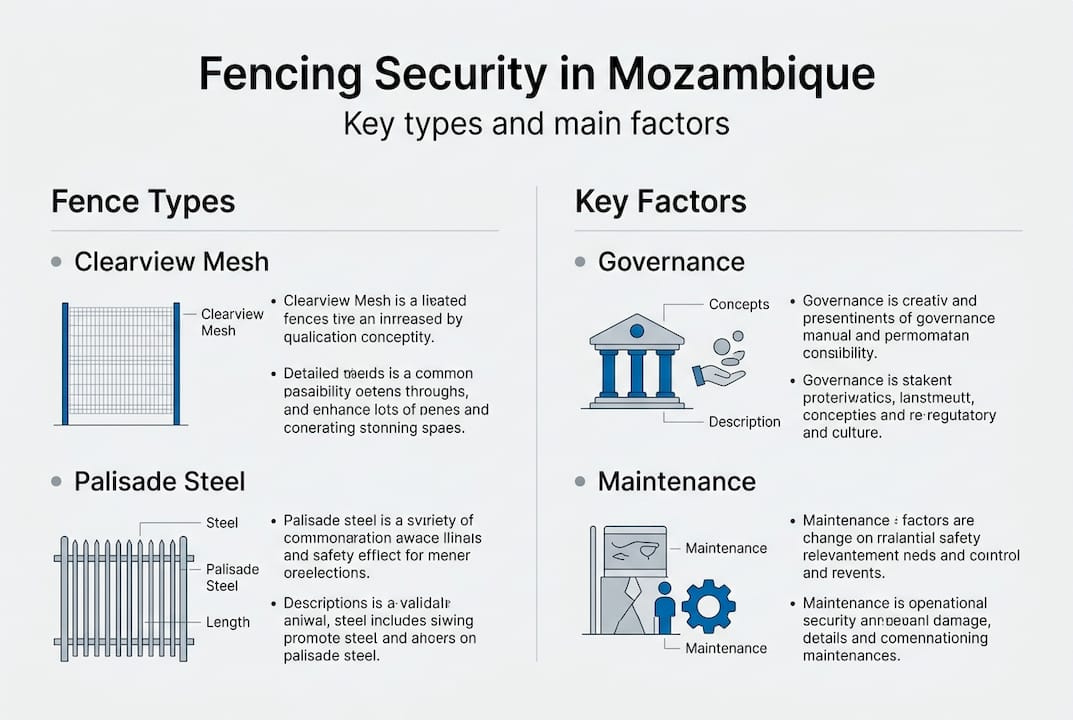
Comparison of main fence types for Mozambique applications
| Fence type | Primary application | Key strength | Key limitation |
|---|---|---|---|
| Clearview mesh (anti-climb/anti-cut) | Commercial, industrial, residential | Visibility, tamper resistance | Higher initial cost |
| Electrified wire | Wildlife, large perimeters | Immediate deterrent | Requires power, ongoing maintenance |
| Concrete/barrier wall | Border control, high-security sites | Physical stopping power | High cost, governance risk |
| Standard weld mesh | Low-risk residential | Economical | Limited anti-climb/cut resistance |
| Palisade steel | Commercial, institutional | Robust visual deterrent | Can be cut at base, no anti-climb mesh |
The numbered considerations below help match each type to Mozambique conditions:
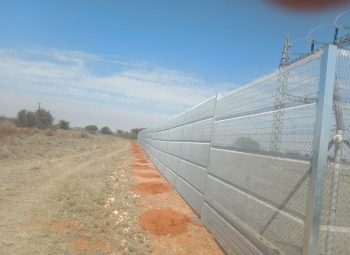
- Clearview mesh panels with small aperture openings (typically 76.2 x 12.7 mm) prevent finger and toe holds, making climbing extremely difficult. These panels are manufactured from high-tensile wire and are the preferred specification for commercial properties, industrial sites, and high-value residential estates.
- Electrified fencing provides an immediate active deterrent and is widely used along wildlife reserve boundaries. The Maputo National Park project of reinforcing 145 km of fence demonstrates that electrified systems can prevent wildlife breaches, although fence formats can become less effective over time as animals adapt, requiring requalification and additional electrification wires.
- Concrete and boundary walls have been proposed and partially implemented along the Mozambique and South Africa border to reduce smuggling and cross-border crime. Funding challenges have affected implementation, and governance irregularities can undermine outcomes even where walls are erected.
- Standard weld mesh suits low-risk environments but should not be specified for sites with elevated security requirements.
- Palisade steel fencing offers a strong visual deterrent and physical robustness but lacks the anti-cut properties of clearview mesh systems.
Pro Tip: For most commercial and light-industrial properties in Mozambique, a clearview mesh system combined with electrification at the top provides the most balanced combination of anti-climb security, visibility for monitoring cameras, and cost-effectiveness over a ten-year lifecycle.
Following the correct industrial fencing installation guide ensures that whichever type is selected, installation quality does not compromise specification performance. The security fence installation process should be treated as a formal project with documented specifications, not an informal procurement exercise.
Design, specifications and installation: Getting the details right
After choosing the right fencing type, knowing the details and specifications is just as critical for reliable protection.
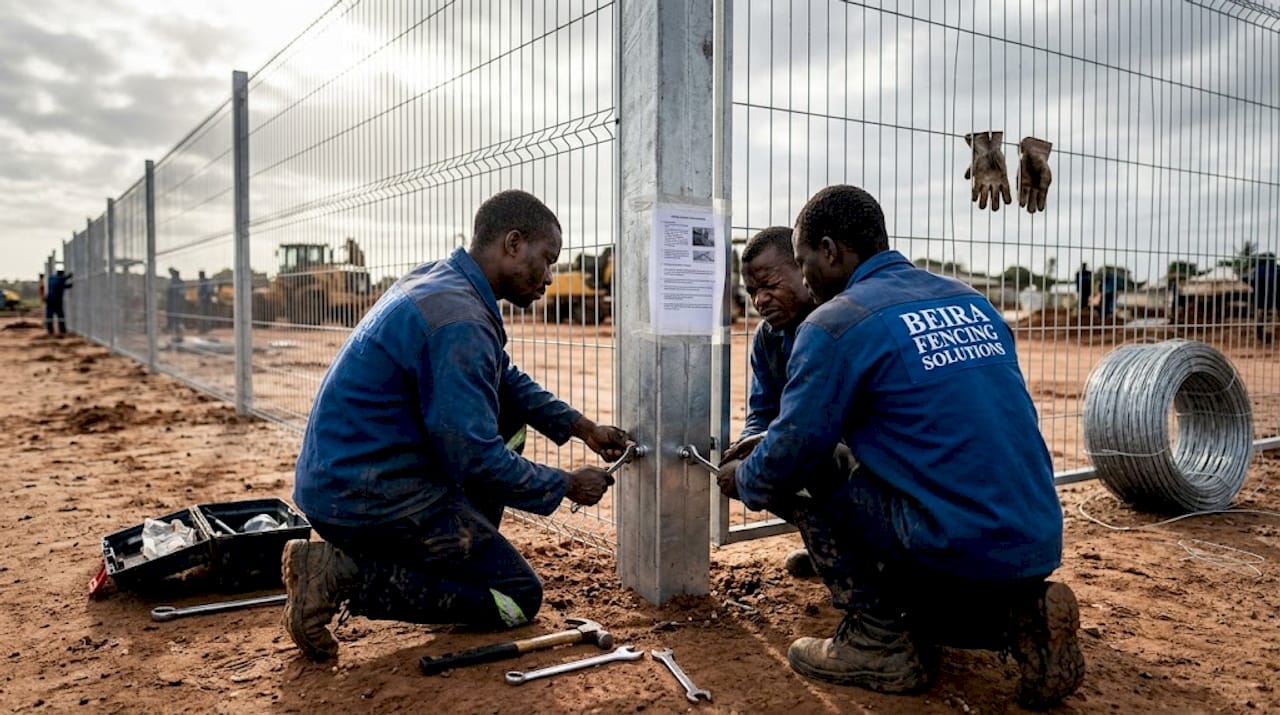
Many fencing projects fail not because the wrong type was selected but because the specifications were incomplete. A high-quality mesh panel installed on undersized posts with inadequate concrete footings will fail under lateral load. Corrosion-prone fasteners will degrade in Mozambique’s coastal and high-humidity inland environments long before the fence itself reaches end of life. Getting the details right from the design phase is non-negotiable for sustained security performance.
Key specification parameters for high-security fencing
| Specification element | Recommended standard | Impact on security |
|---|---|---|
| Mesh aperture | 76.2 x 12.7 mm or smaller | Anti-climb, anti-cut |
| Wire diameter | Minimum 3 mm high-tensile | Cut resistance |
| Post spacing | Maximum 3 m centres | Panel rigidity |
| Post embedment depth | Minimum 600 mm concrete | Stability under force |
| Corrosion protection | Heavy galvanised or powder-coated | Longevity in humid climates |
| Gate hardware | Tamper-proof fasteners, lockable | Controlled access |
UN procurement specifications for high-security perimeter fencing in the region emphasise resistance to climb and cut as primary requirements, combined with system completeness covering posts, fasteners and clamps, corrosion-matched installation details, and optional hardening such as razor wire toppers and reinforced gates.
The following elements are critical components that property owners should confirm are included in any specification document:
- Anti-climb mesh panels with verified aperture dimensions and wire diameter documentation
- Galvanised or powder-coated posts sized to resist lateral loading without permanent deformation
- Tamper-proof fasteners and clamps that cannot be removed with standard hand tools
- Concrete footings at specified depth and diameter for Mozambique’s soil conditions
- Gate systems with anti-lift hinges and multi-point locking mechanisms
- Corrosion class matching the site’s environmental exposure category, particularly for coastal Mozambique locations
Key specification insight: Research from established procurement frameworks indicates that specifying anti-cut wire diameter at 3 mm or above reduces successful cutting attempts by a substantial margin compared to standard 2 mm wire used in basic installations. This is a detail that significantly changes security outcomes without dramatically increasing material cost.
Understanding the full fencing installation process before contracting an installer allows you to ask the right questions and verify that critical specification elements are not being substituted to reduce costs. The commercial fencing benefits of correct specification extend well beyond security, including insurance premium reductions, compliance with occupational health requirements, and improved property valuations.
Corrosion resistance deserves particular emphasis for Mozambique contexts. Coastal sites in Maputo, Beira, and Inhambane face salt-laden air that accelerates corrosion on inadequately protected steel. Specifying heavy galvanised or marine-grade powder-coated finishes with a documented coating thickness of at least 60 microns ensures the fence retains structural integrity and appearance throughout its intended service life.
Project success factors: Governance, upgrades and common pitfalls
With installation covered, it is essential to keep projects on track and avoid common mistakes that undermine long-term security.
Even technically correct fence installations can fail to deliver security outcomes if project governance, procurement, and ongoing management are not properly handled. This is a reality documented at scale in Mozambique’s border infrastructure projects, and it applies equally to private property and industrial facility projects.
Border wall funding difficulties along the Mozambique and South Africa border illustrate that concrete and boundary-style barriers intended to stop cross-border crime can show measurable impact, but they also face significant implementation and governance challenges, including funding shortfalls and tender legality questions. Property owners contracting large fencing projects must apply similar discipline to procurement and contract management.
Key pitfalls to avoid in Mozambique fencing projects include:
- Incomplete perimeter coverage: Leaving gaps or low-specification sections creates exploitable weak points that undermine the entire installation.
- Informal procurement: Accepting verbal specifications or unverified contractor credentials increases the risk of substandard installation.
- Ignoring upgrade paths: Planning for a static installation without budgeting for future upgrades is a structural error in project design.
- Deferred maintenance: Corrosion, damaged panels, and sagging posts that are left unaddressed progressively reduce security performance.
- Single-layer reliance: Treating the fence as the complete security system rather than integrating it with monitoring, lighting, and response protocols.
Pro Tip: Build a five-year maintenance and upgrade budget into your initial fencing project plan. Fencing that is not maintained degrades in both physical security performance and deterrent value, and retrofit upgrades cost significantly more than planned incremental maintenance.
The Maputo National Park fencing upgrades provide a useful model for private property managers: electrified and high-tensile systems can lose effectiveness as target actors adapt, whether those actors are elephants learning to break through specific fence formats or intruders who study a static system over time. Planning should explicitly include upgrade paths, such as requalification of electrification, addition of sensor wires, and panel reinforcement, rather than treating installation as a one-time event.
Effective fencing project management requires documented scope, material specifications, contractor obligations, and inspection protocols at defined milestones. The challenges specific to urban fencing in South Africa and the broader region reflect similar governance and compliance requirements that Mozambique-based property owners should adopt as standard practice.
A smarter approach: Beyond barriers for lasting security
Putting it all together, let us consider an approach to Mozambique security that is practical and future-proof.
Conventional wisdom in property security overstates what a fence alone can achieve. We have observed, across multiple project contexts, that the most expensive fence specification will underperform if the governance surrounding its procurement, installation, and maintenance is weak. This is not a theoretical risk; court decisions overturning fencing contracts due to procurement irregularities demonstrate that barriers can fail before a single intruder approaches them.
The contrarian view that experienced security planners hold is this: governance and adaptive upgrades matter more than the initial fence specification. A moderately specified fence that is actively monitored, regularly maintained, and upgraded as threats evolve will outperform an over-engineered installation that is left static for five years. Both humans and animals are adaptive. Any security measure that does not account for adaptation is a measure with a built-in expiry date.
Sound fencing project management produces security that is durable precisely because it treats the fence as a living component of an integrated system rather than a finished product. The most resilient Mozambique security installations we are aware of combine clearview anti-climb fencing with electrification, camera monitoring, formal maintenance schedules, and documented upgrade triggers. That is the standard worth pursuing.
Connect with expert fencing solutions for Mozambique properties
Having learned the realities and pitfalls of fencing security in Mozambique, the logical next step is connecting with providers who can translate these principles into correctly specified, professionally installed systems tailored to your property’s specific risk profile.
Jumalu Tech specialises in the manufacturing, supply, and installation of Clearview high-security fencing systems that meet anti-climb and anti-cut specifications suited to commercial, industrial, and high-value residential properties. Our team provides detailed guidance from initial specification through installation and long-term maintenance planning. If you are uncertain about which system best suits your Mozambique property, reviewing our fencing terminology guide and the full range of mesh fencing options available is an excellent starting point before requesting a formal quotation.
Frequently asked questions
Is fencing alone enough for property security in Mozambique?
No, fencing acts as a deterrent but functions as a first-line defence and is most effective when combined with active patrols, monitoring systems, and controlled access protocols.
Which fencing type is best for preventing wildlife breaches?
Electrified fences are the standard choice for wildlife boundaries, but regular upgrades are essential because animals can adapt over time and break through static fence formats, requiring requalification and additional wires.
What are common pitfalls in fencing projects?
Poor governance, incomplete perimeter coverage, and absence of upgrade planning are the most common failures, with documented cases showing that even large-scale projects lose security effectiveness when procurement and execution are flawed.
How can fencing resist forced entry or vandalism?
Specifying anti-climb mesh with small apertures, high-tensile wire at minimum 3 mm diameter, tamper-proof fasteners, and hardening add-ons such as razor wire toppers significantly improves resistance, as regional procurement standards confirm.
Do fences need maintenance and upgrades?
Yes, ongoing maintenance and planned upgrade paths are essential because both human intruders and wildlife can adapt to static systems over time, reducing the effectiveness of an unchanged installation.
Recommended
- Security Rating in Fencing – Why It Matters in South Africa – Jumalu Fencing
- Fencing and Urban Security – Impact on South African Spaces – Jumalu Fencing
- Commercial Security Fencing Benefits: Complete Guide South Africa – Jumalu Fencing
- Clear View Fencing: Complete Guide for South Africa – Jumalu Fencing