TL;DR:
- Not all fencing finishes provide the same level of long-term protection, and poor quality coatings lead to costly repairs. Powder coated fencing offers superior durability and aesthetic appeal but is not indestructible, requiring proper application and maintenance to maximize lifespan. Understanding the process, strengths, limitations, and environmental considerations of powder coating is essential for making informed fencing choices.
Not all fencing finishes deliver equal protection, and this misunderstanding costs South African property owners thousands of rands every year in premature repairs and replacements. Powder coated fencing has earned a strong reputation across residential, commercial, and industrial sites throughout Gauteng and beyond, yet many buyers still purchase based on price alone, overlooking the critical role that finish quality plays in long-term security and property value. This guide clarifies exactly what powder coated fencing is, how it is applied, where it excels, where its limits lie, and how to maintain it correctly for maximum return on investment.
Table of Contents
- Understanding powder coated fencing: the basics explained
- How the powder coating process works
- Advantages and limitations: when powder coating excels (and when it doesn’t)
- Maintenance and longevity: keeping your powder coated fence in top condition
- Why most property owners underestimate the impact of fence finish quality
- Unlock the value of professionally installed powder coated fencing
- Frequently asked questions
Key Takeaways
| Point | Details |
|---|---|
| Superior durability | Powder coated fencing resists chipping, peeling, and harsh weather far better than standard painted options. |
| Not foolproof | Breaches in the coating can expose the metal beneath to corrosion, and repairs require professional attention. |
| Maintenance matters | Routine care and swift response to scratches are essential for maximizing longevity. |
| Right fit for conditions | In coastal or high-impact areas, a duplex (galvanised plus powder coat) system offers the best protection. |
| Professional installation pays off | Expert application and specification ensure the full benefits of powder coated fencing for South African properties. |
Understanding powder coated fencing: the basics explained
Powder coated fencing refers to metal fencing that has been finished using a dry powder paint process, where the coating is electrostatically applied and then heat-cured to form a hard, uniform shell over the metal substrate. Unlike conventional liquid paint, which sits on the surface and is prone to peeling, the powder coating bonds chemically with the metal during the curing process. The result is a finish that is noticeably thicker, more uniform, and far more resistant to mechanical abrasion and environmental exposure.
This distinction matters enormously in the South African context. Properties along the KwaZulu-Natal coast face salt-laden air that rapidly corrodes unprotected metal, while properties in Gauteng deal with intense UV radiation and heavy summer rains. Powder coated fencing is specifically valued because it addresses both of these challenges with a single, clean finish that also happens to look exceptionally good.
Key benefits of powder coated fencing include:
- Durability: The cured coating is significantly harder than liquid paint, resisting minor impacts, scratches, and abrasion during normal use.
- Aesthetic appeal: Available in a wide range of colours and textures, it allows for a clean, modern finish that maintains its appearance far longer than painted alternatives.
- Weather resistance: The sealed coating prevents moisture ingress and resists UV-induced fading under normal conditions.
- Low maintenance: Routine cleaning is all that is required in most environments, with no need for regular repainting.
“Powder-coated fencing is selected for durability and lower maintenance versus conventional liquid-painted finishes, but it is not ‘indestructible’.”
It is this last point that many buyers miss. Powder coating is not a permanent, damage-proof shield. Understanding the advantages of Clear View Fencing in the context of its finish quality helps property owners set realistic expectations and make better decisions from the outset.
How the powder coating process works
The quality of a powder coated fence is determined almost entirely by how carefully the manufacturing and application process is followed. Cutting corners at any stage introduces weaknesses that may not be visible at installation but will emerge within a few years of service.
The process follows three clearly defined stages:
- Surface preparation: The metal substrate is cleaned of all mill scale, rust, oil, and contaminants using sandblasting, chemical etching, or a combination of both. This is the most critical stage. Any contamination left on the surface prevents the powder from bonding correctly, which leads to premature peeling and localised corrosion.
- Electrostatic powder application: The dry powder, which is a blend of resin and pigment, is sprayed onto the prepared metal using an electrostatic gun. The gun imparts a positive charge to the powder particles, which are then attracted to the grounded metal and adhere uniformly across all surfaces, including tight corners and weld seams.
- Oven curing: The coated fencing component is placed in an industrial oven at temperatures typically between 160°C and 200°C. The heat causes the powder to melt, flow, and chemically crosslink into a continuous, hard film. This controlled manufacturing process is what distinguishes powder coating from all liquid paint alternatives.
| Stage | Key requirement | Failure risk if skipped |
|---|---|---|
| Surface preparation | Full removal of contaminants | Poor adhesion, early rust under coating |
| Electrostatic application | Even coverage, correct gun settings | Thin spots, inconsistent finish |
| Oven curing | Correct temperature and duration | Soft, brittle coating with reduced adhesion |
Pro Tip: When sourcing powder coated fencing, always ask the supplier to confirm whether surface preparation is done via sandblasting or acid etching. Panels that are only wiped clean before coating will fail far sooner, particularly in humid or coastal environments.
Understanding the fence installation process from preparation through to curing helps you ask the right questions when comparing quotations, because two fences that look identical on the day of installation may perform very differently over a ten-year period.
Advantages and limitations: when powder coating excels (and when it doesn’t)
With the fundamentals of the powder coating process clear, how does it stack up in real-world use? The answer requires a balanced view that acknowledges both genuine strengths and real vulnerabilities.
Comparative strengths:
- Powder coated surfaces resist chipping and peeling far better than liquid paint because the coating bonds at a molecular level rather than simply adhering mechanically to the surface.
- UV resistance is substantially better in most formulations, which is significant given South Africa’s high solar irradiance levels. Quality powder coatings retain colour and gloss for many years without chalking.
- The sealed surface is inhospitable to mould and fungal growth, which is relevant in high-humidity coastal regions.
- Because the coating covers all surfaces uniformly, including welds and cut edges when applied post-fabrication, there are fewer entry points for moisture.
Limitations that property owners must understand:
- Powder coating is more resistant to chipping than paint, but it is not immune. An impact from a heavy object, power tool, or attempted forced entry can breach the coating and expose bare metal, which will then corrode if not treated promptly.
- Repairs are genuinely difficult. Unlike liquid paint, you cannot simply brush over a damaged area and achieve a seamless result. Touch-up solutions exist but are rarely invisible and never match the hardness of the original cured coat.
- In harsh coastal or industrial environments, coating benefit depends heavily on exposure intensity, which is why experienced specifiers often upgrade to a duplex system.
A duplex system combines hot-dip galvanising (a zinc coating applied to the steel) with powder coating applied over the top. The galvanising acts as a sacrificial layer that continues to protect the steel even if the powder coat is breached, while the powder coat protects the zinc from its own form of corrosion. This combination is the specification of choice for coastal, industrial, and high-impact applications.
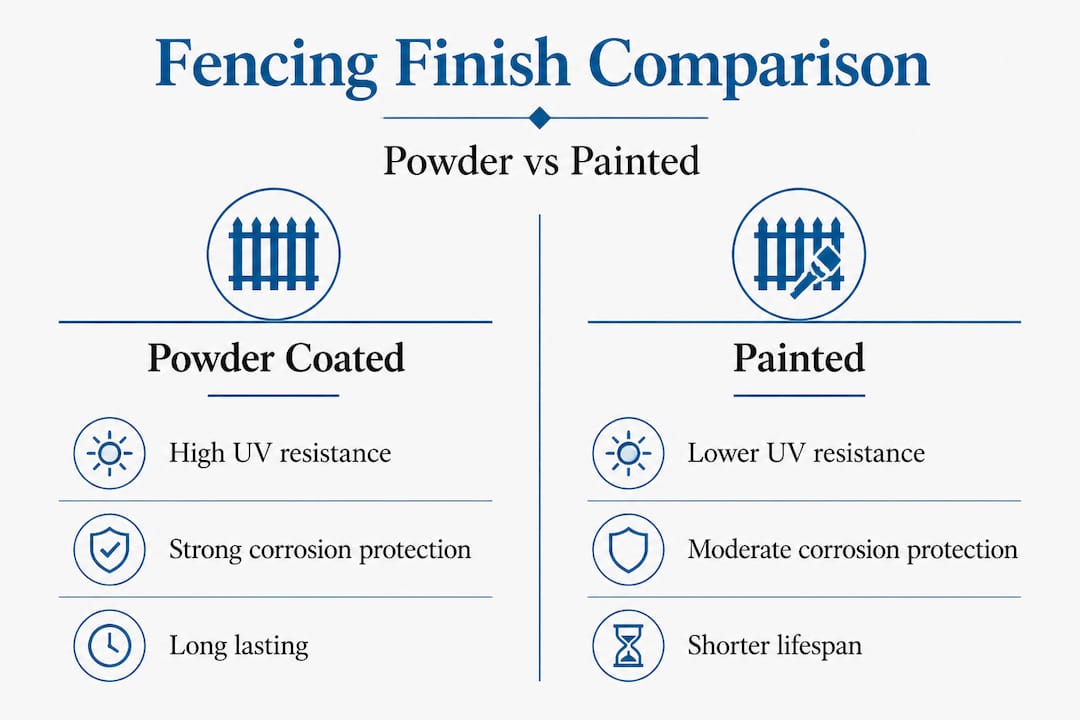
| Finish type | UV resistance | Corrosion resistance | Repairability | Recommended environment |
|---|---|---|---|---|
| Standard liquid paint | Low | Low | Easy | Low-exposure residential |
| Powder coat only | High | Medium to high | Difficult | Inland, urban, low impact |
| Duplex (galvanised + powder coat) | High | Very high | Moderate | Coastal, industrial, high impact |
Reviewing the full range of types of commercial fencing available in South Africa will help you match the right specification to your specific site conditions, particularly if your property falls into a higher-risk environmental category. For large-scale operations, the industrial fencing installation guide provides further guidance on specifying correctly from the outset.
Maintenance and longevity: keeping your powder coated fence in top condition
Understanding the limitations and strengths of powder coated fencing lets you put the right care practices in place and maximise your investment over its full service life.
Routine maintenance is straightforward and requires no specialist products or skills:
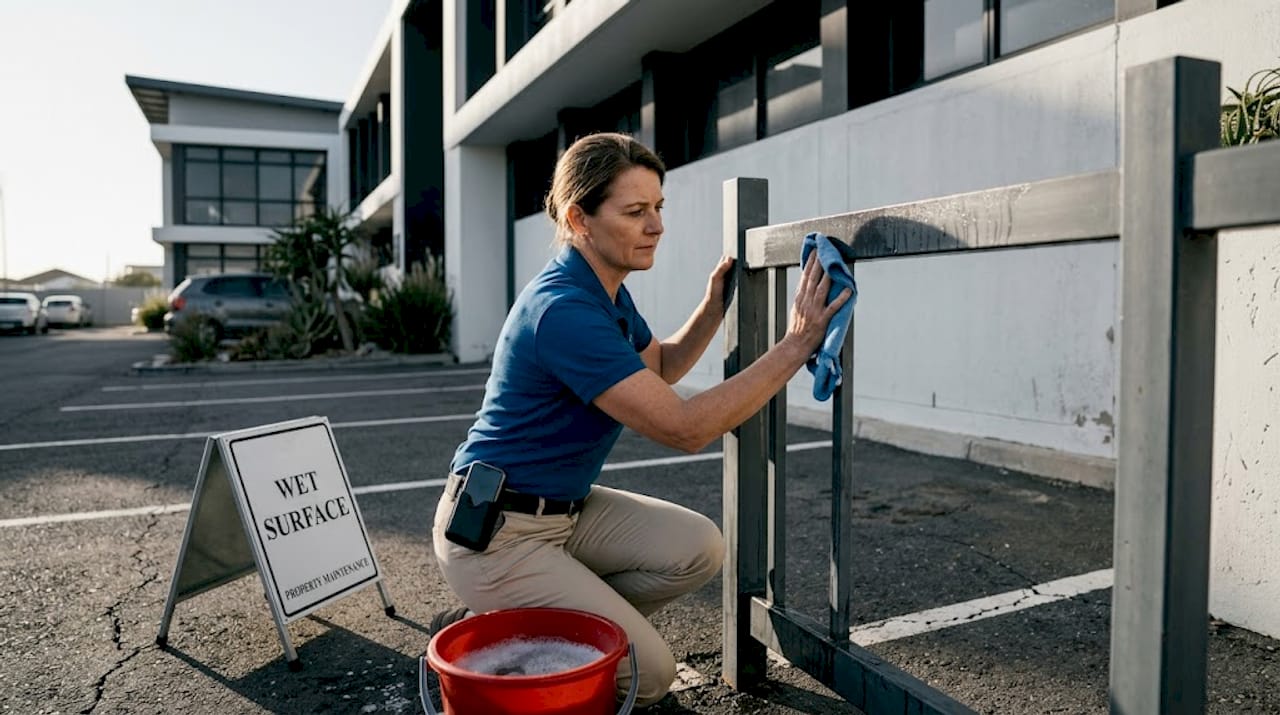
- Clean the fence surface every three to six months using a mild detergent and water, applied with a soft cloth or low-pressure hose. This removes accumulated dust, industrial fallout, bird droppings, and organic matter that can trap moisture against the coating.
- Inspect all weld points, cut edges, and mounting brackets at each cleaning cycle. These are the areas most likely to show early signs of coating failure because they present irregularities in the surface that are harder to coat evenly.
- Remove any vegetation in contact with the fence promptly. Climbing plants and overgrown grass trap moisture and accelerate localised corrosion even through a quality powder coat finish.
- Address any scratches or chips immediately. When coating breaches expose metal, corrosion can begin within weeks in humid or coastal conditions, and touch-ups are harder to execute correctly than with standard paint systems. Clean the area, apply a suitable zinc-based primer to the exposed metal, and consult a professional for a proper repair assessment.
- Schedule a professional inspection every two to three years to identify areas where the coating may be thinning or showing micro-cracks that are not visible to the untrained eye.
Pro Tip: Never use abrasive cleaning pads, wire brushes, or solvent-based cleaners on powder coated fencing. These strip or soften the surface layer and create micro-abrasions that allow moisture to penetrate gradually, reducing the effective lifespan of the fence by years.
For property owners managing multiple fence lines or larger perimeter installations, the maintenance guide for ClamberPrufe provides structured inspection protocols that can be adapted for any powder coated system. The fencing project management guide outlines how to plan maintenance schedules from the moment of installation, ensuring that costs remain predictable and the fence performs at specification throughout its service life. Proper documentation of the fencing installation process also provides a baseline record against which future condition assessments can be compared.
Why most property owners underestimate the impact of fence finish quality
Across hundreds of fencing installations throughout South Africa, a consistent pattern emerges: buyers focus almost exclusively on the unit price per metre and the visual appearance of a new fence, while the questions that determine long-term value, specifically coating quality, substrate preparation standards, and environmental specification, rarely get asked until a problem becomes visible.
The financial consequences of this approach are significant. A fence installed with inadequate surface preparation may begin showing surface rust within three to five years. Repainting or recoating an installed fence is expensive, disruptive, and technically challenging because the same quality outcome achieved in a controlled factory environment cannot be fully replicated on site. In many cases, premature failure means a full replacement rather than a repair, which negates any saving made on the initial purchase price.
There is also a security dimension that is frequently overlooked. A fence whose coating has deteriorated and whose steel is actively corroding is structurally weaker than a properly maintained installation. Pitting corrosion reduces the cross-sectional area of fence components, lowering their resistance to forced entry or impact loading. This is not a hypothetical concern in the South African environment, where perimeter security is a primary driver of fencing investment.
The key insight from professional experience is this: coating quality and exposure conditions interact in ways that cannot be separated, meaning a product that performs adequately in a sheltered Pretoria suburb will fail prematurely on an exposed coastal property or an industrial site with chemical fallout in the air. Most suppliers do not proactively explain this to buyers, and most buyers do not ask.
The recommendation from professionals is to look beyond the standard product offering and evaluate whether the specification matches the actual site conditions. Reviewing the types of mesh fencing available can illustrate how different substrate and finish combinations are engineered for specific environments, giving you a useful framework for assessing whether a quoted product is truly fit for purpose on your property.
Unlock the value of professionally installed powder coated fencing
Knowing the real performance characteristics of powder coated fencing puts you in a strong position to demand the right specification, ask the right questions, and hold suppliers accountable for installation quality. Jumalu Tech applies this same rigour to every project, from initial site assessment through to final inspection.
Our ClamberPrufe Clearview Fencing range combines high-tensile, weather-resistant steel construction with professionally applied powder coating, engineered specifically for South African conditions. Whether your requirement is residential perimeter security, commercial access control, or large-scale industrial protection, the ClamberPrufe Clear View Fencing system delivers unobstructed visibility alongside anti-climb and anti-cut security. We also offer an extensive selection of types of mesh fencing to complement your specific site requirements. Contact Jumalu Tech today to receive a detailed quotation tailored to your property’s environmental and security specifications.
Frequently asked questions
Is powder coated fencing better than painted fencing for coastal areas?
Powder coated fencing offers significantly better resistance to chipping and general weather than liquid-painted alternatives, but for coastal areas a duplex system combining galvanising with powder coating is recommended for maximum corrosion protection given the salt-laden environment.
How long does powder coated fencing typically last?
When professionally installed and maintained correctly, powder coated fencing can deliver 20 or more years of reliable service, though premature damage from impacts, poor surface preparation, or neglected maintenance will reduce that lifespan considerably.
What should I do if my powder coated fence is scratched or chipped?
Clean the affected area immediately, apply a zinc-based primer to any exposed metal, and consult a professional repair service, because coating breaches can allow corrosion to develop rapidly at the exposed point and touch-ups are technically demanding.
Does powder coated fencing require special maintenance?
No special products are required. Routine washing with mild detergent and water every three to six months, combined with periodic visual inspections, is sufficient to maintain the coating and catch early-stage surface deterioration before it becomes a structural issue.
Can powder coated fencing be customised to match property colours?
Yes. Powder coating is available in an extensive range of colours and textures, allowing the fencing finish to be matched closely to architectural palettes, corporate colours, or specific aesthetic requirements without any compromise to coating performance.
Recommended
- Complete Guide to Fencing Materials and Choices – Jumalu Fencing
- Security Fencing Terminology Explained: Complete Guide – Jumalu Fencing
- Aesthetic Security Fencing Options: Style Meets Safety – Jumalu Fencing
- Fencing Installation Process for Secure Properties – Jumalu Fencing
- Why glass barriers beat wood and metal for outdoor safety – The Glass Railing Store