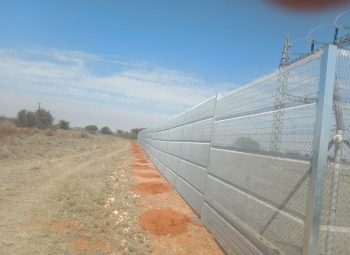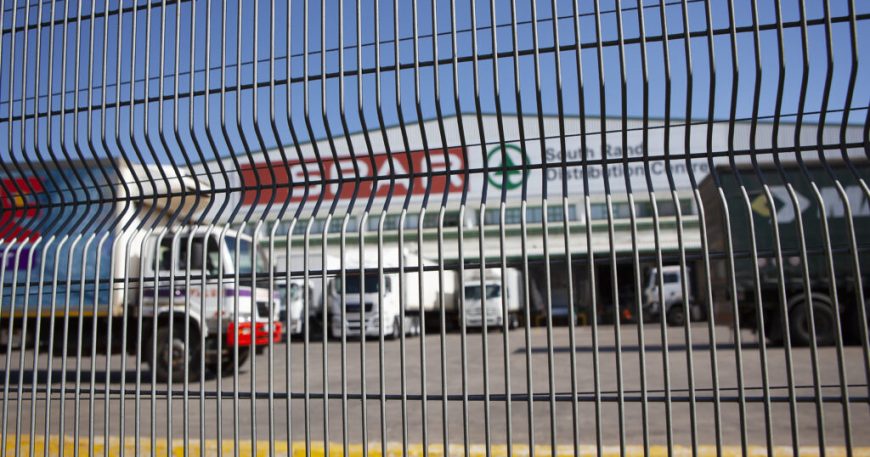
TL;DR:
- South African logistics face rising cargo theft due to sophisticated syndicates exploiting perimeter vulnerabilities.
- Properly specified security fencing enhances deterrence, delay, detection, and regulatory compliance.
- A layered security approach combining physical fencing with electronic systems provides the best protection and ROI.
South Africa’s logistics sector faces a security crisis that demands more than optimism and outdated perimeter solutions. With R7 billion in annual cargo theft losses and criminal syndicates growing in sophistication, the gap between what basic fencing offers and what industrial facilities actually need has never been wider. Many property developers and facility managers still operate under the assumption that a standard wall or simple fence constitutes adequate protection. This guide examines why that assumption is not only incorrect but genuinely costly, and how correctly specified, professionally installed security fencing transforms risk exposure, regulatory compliance, and operational resilience across South African logistics facilities.
Table of Contents
- The reality of security risks in South African logistics
- Why fencing is a frontline defense in logistics
- Limitations, edge cases, and the myth of ‘enough’ fencing
- Integrated security: The layered approach for resilience and ROI
- Why the ‘walls are enough’ mindset puts your business at risk
- Upgrade your logistics security with expert fencing solutions
- Frequently asked questions
Key Takeaways
| Point | Details |
|---|---|
| Security fencing cuts risk | Up-to-date fencing reduces cargo theft and damage by up to 50 percent in South African logistics. |
| Layered approaches win | Physical barriers alone are not enough and must be combined with technology and staff procedures for maximum security. |
| Compliance matters | Certified, regulation-compliant fencing lowers insurance risk and ensures legal safety for facility managers and developers. |
| ROI can be rapid | Properly integrated fencing and security systems often pay for themselves within one to two years by averting major incidents. |
The reality of security risks in South African logistics
To fully appreciate why fencing plays such a pivotal role, it is necessary to examine the current risk environment in detail. South African logistics operations face a constellation of threats that are both persistent and evolving, and the financial toll they extract is staggering.
Cargo theft in South Africa is not an isolated or opportunistic problem. Organised syndicates operate with military-level coordination, exploiting predictable vulnerabilities at warehouses, distribution centres, and freight depots. The 59% surge in Q3 2023 thefts illustrates how rapidly the threat landscape escalates when facility security fails to keep pace. These are not smash-and-grab incidents. They are planned, executed quickly, and often involve inside knowledge of facility layouts and response protocols.
| Threat category | Frequency | Estimated financial impact |
|---|---|---|
| Organised cargo theft | Very high | R100 000 to R1.5 million per incident |
| Opportunistic perimeter breach | High | R20 000 to R500 000 |
| Insider-assisted theft | Moderate to high | R250 000+ per incident |
| Vehicle ramming and forced entry | Moderate | R300 000 to R2 million |
| Damage during load shedding periods | High | Variable; equipment and cargo loss |
The common threads across these threats are exploitable weaknesses in perimeter design and inadequate integration with broader security measures. Key vulnerability factors include:
- Wide mesh spacing that permits item extraction without full perimeter breach
- Standard galvanised fencing that can be cut with commercially available tools in under three minutes
- Electric fencing systems that are rendered inactive during load shedding, creating predictable windows for criminal activity
- Poor maintenance resulting in compromised posts, corroded wire, and gaps at ground level
- Inadequate lighting and sightlines that obscure perimeter activity from patrol and CCTV systems
Understanding fencing and urban security in South Africa’s specific context is therefore essential, because threats faced by logistics facilities differ substantially from those at residential or retail sites. The scale of throughput, the value of stored inventory, and the geographic exposure of large warehousing facilities create a risk profile that demands certified, specification-grade fencing solutions rather than cost-minimised alternatives. The commercial security fencing benefits extend well beyond simple deterrence, encompassing insurance positioning, liability management, and regulatory standing.
“Basic fencing is not a security solution. It is a boundary marker. The distinction costs South African businesses billions each year.”
Why fencing is a frontline defense in logistics
Knowing the risks, what role does fencing really play, and why is it prioritised in South African logistics security strategies? The answer lies in the fundamental security principles of deterrence, delay, and detection. Fencing addresses the first two directly and creates the structural conditions for effective detection systems.
Well-specified perimeter fencing serves as the visible, physical statement that a facility is hardened against intrusion. This psychological deterrence is well-documented. Criminal syndicates conduct threat assessments before targeting a facility, and a facility with visible, robust fencing, rated anchoring posts, and clear sightlines presents a far less attractive target than one secured by a standard palisade or brick wall. However, fencing provides deterrence and delay rather than an absolute prevention guarantee, which is why integration with detection and response systems is non-negotiable.
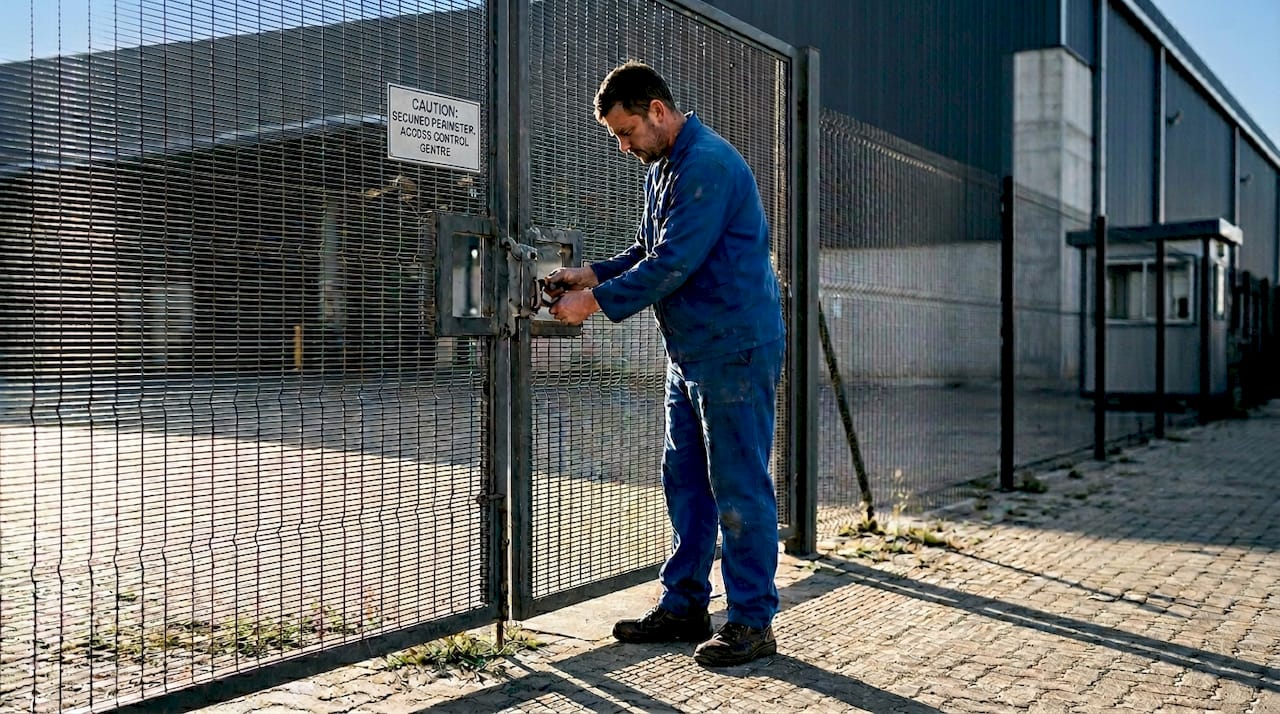
From a regulatory and insurance standpoint, certified fencing solutions are increasingly mandatory rather than optional. Many South African insurers require documented evidence of compliant perimeter security before underwriting logistics facilities, and substandard solutions can void claims in the event of a breach. South African occupational health and safety regulations also impose obligations on facility managers regarding perimeter integrity, particularly where vehicles, machinery, and high-value inventory are co-located.
| Fencing type | Deterrence value | Anti-cut/anti-climb rating | Maintenance requirement | Integration capability |
|---|---|---|---|---|
| Standard brick or concrete wall | Moderate | Low (climbing easy) | High | Poor sightlines |
| Basic palisade fencing | Low to moderate | Low | Moderate | Limited |
| Welded mesh panel fencing | High | Moderate to high | Low | Excellent |
| Anti-climb clearview fencing | Very high | Very high | Low | Excellent |
| Electric fencing (standalone) | Moderate | Low (power-dependent) | High | Moderate |
The correct specification of perimeter fencing for industry therefore requires a structured approach rather than a price-driven selection process. The following numbered best practices guide effective implementation:
- Conduct a formal threat assessment before selecting fencing specifications, mapping actual risk vectors to physical perimeter design.
- Select certified, rated fencing materials appropriate for the threat profile, including anti-climb, anti-cut welded mesh panels with tamper-resistant fixings.
- Ensure adequate post depth and anchoring, as undermining or lifting fencing at the base is a common attack method against poorly installed systems.
- Design for sightlines, choosing clearview or mesh options that allow full CCTV and patrol visibility rather than creating concealment behind solid barriers.
- Integrate perimeter intrusion detection systems (PIDS) directly into fencing infrastructure from the design phase.
- Schedule quarterly maintenance inspections and document findings, both to maintain physical integrity and to satisfy insurer and regulatory requirements.
Understanding industrial fencing requirements in South Africa is essential before committing to a fencing specification, as site classification, stored goods value, and proximity to high-risk areas all influence the minimum acceptable standard.
Pro Tip: Do not allow procurement decisions to be driven by upfront material cost alone. The cost of a single cargo theft incident frequently exceeds the price difference between a basic and a certified high-security fencing system many times over.
Limitations, edge cases, and the myth of ‘enough’ fencing
However, no security solution is perfect. Many facilities are still compromised even after significant fencing investment, and understanding where traditional approaches fall short in real scenarios is critical to avoiding costly assumptions.
The most frequently exploited limitation in South African logistics is load shedding vulnerability. Electric fencing, which many facility managers treat as a primary perimeter solution, is rendered inactive during power outages. Stage 4 and Stage 6 load shedding creates multiple predictable windows each day during which electric barriers offer no protection whatsoever. Sophisticated criminal syndicates track load shedding schedules with precision and time operations accordingly.
Beyond power dependency, the following vulnerabilities are consistently observed at compromised South African logistics sites:
- Insider collusion accounts for approximately 25% of all facility thefts, meaning perimeter security is bypassed entirely rather than defeated
- Vehicle ramming at access gates and dock areas, exploiting the structural weakness of standard gate posts and hinges
- Tool-assisted cutting through mesh panels with insufficient wire diameter or low tensile specification, achievable in under three minutes with battery-powered cutters
- Item extraction through wide mesh spacing, which does not require a full perimeter breach and leaves no immediately visible evidence of intrusion
- Response time gaps of 10 to 15 minutes between alarm activation and armed response arrival, which is more than sufficient for a coordinated extraction
“A perimeter breach detected in 30 seconds but responded to in 12 minutes is, operationally, the same as a perimeter that was never breached at all. Detection without response is theatre.”
These realities do not argue against investing in quality fencing. They argue against treating fencing as a standalone solution. Reviewing fencing installation guides for high-risk sites makes clear that installation quality, post spacing, wire gauge, and mesh aperture must all be specified in relation to the actual threat environment rather than minimum regulatory thresholds. Similarly, understanding the full scope of fencing requirements applicable to your site category prevents the common error of assuming that basic compliance equates to adequate protection.
Pro Tip: Combine physical fencing with electronic detection, battery-backed power systems, dual-redundant CCTV coverage, and clearly documented response protocols. Physical barriers buy time. The value of that time depends entirely on how quickly and effectively your detection and response systems activate.
Integrated security: The layered approach for resilience and ROI
To overcome these limitations and deliver real security, South Africa’s leading logistics operators are adopting a layered approach. Here is how that looks in practice, and why the return on investment is compelling for both property developers and facility managers.
The layered security approach combines three mutually reinforcing elements: physical barriers, electronic systems, and personnel protocols. No single layer is sufficient alone, but each layer significantly increases the effort, risk, and time required for a successful breach, making the facility a less attractive target and improving detection probability at each stage.
| Security element | Standalone cost estimate | Annual incident cost without it | Combined ROI period |
|---|---|---|---|
| Certified perimeter fencing | R150 000 to R800 000 | R500 000 to R2 million per incident | 12 to 24 months |
| PIDS and CCTV integration | R80 000 to R250 000 | Detection failure cost variable | 12 to 18 months |
| Backup power for electronic systems | R30 000 to R120 000 | Full electric perimeter loss during shedding | 6 to 12 months |
| Access control and gate management | R50 000 to R200 000 | Insider threat mitigation value | 18 to 36 months |
| Armed response SLA upgrade | R3 000 to R10 000 per month | Reduced per-incident loss | Immediate |
The sequential steps for effective layered deployment follow a clear logic:
- Complete the physical perimeter first, using correctly rated anti-climb, anti-cut mesh or clearview fencing as the foundation layer.
- Install PIDS directly onto the fencing infrastructure, using vibration, tension, or infrared detection calibrated to reduce false alarms without sacrificing sensitivity.
- Establish full CCTV coverage of the perimeter with overlapping camera fields and remote monitoring capability.
- Install battery backup or generator systems for all electronic security components, eliminating load shedding as a vulnerability.
- Implement access control protocols that limit insider access to sensitive zones and create audit trails for all personnel movements.
- Review and test the integrated system quarterly, including deliberate breach simulations to identify gaps before criminal actors do.
Understanding security rating for fencing in South Africa is critical at step one, because the security rating of a fencing system determines which electronic detection layers will integrate effectively and what insurer requirements can be satisfied. Engaging certified fencing installation services from the outset ensures that both physical specification and installation quality meet the standards required for layered integration.
Pro Tip: Match your fencing specification to your actual threat profile rather than minimum regulatory requirements. A facility handling high-value electronics or pharmaceutical goods requires a fundamentally different specification than one storing construction materials. The payback period on appropriate over-specification is consistently shorter than the cost of a single incident at an under-specified facility.
Why the ‘walls are enough’ mindset puts your business at risk
What does all this mean if you are a property developer or facility manager responsible for safety and compliance in South Africa? It means that one of the most persistent and costly assumptions in the industry deserves to be challenged directly and publicly.
The belief that a solid wall or a standard perimeter fence constitutes adequate security is not merely outdated. It is an active liability. South African logistics operators lose billions each year not because perimeter security does not exist at their facilities, but because the security that exists was specified for a threat environment that no longer applies. Criminal syndicates have outpaced standard fencing solutions. They know average response times, they know load shedding schedules, and they know that most facilities maintain a visible perimeter without the integrated systems needed to act on a detected breach.
The myth that walls alone are enough persists partly because perimeter breaches are rarely classified and reported as fencing failures. They appear in incident reports as theft events, insurance claims, or operational disruptions. The root cause analysis that would reveal perimeter inadequacy as the primary enabler is rarely conducted rigorously or acted upon systematically. This creates a cycle where the same vulnerabilities are exploited repeatedly without triggering meaningful changes to fencing specification or installation standards.
Real security, in our experience, comes from a willingness to question the assumptions embedded in past infrastructure decisions and to invest in context-appropriate, threat-matched solutions. The advantages of anti-climb fencing at logistics facilities are well-documented, and the cost differential between standard and rated anti-climb systems is consistently justified by incident prevention outcomes. What is not justified is the assumption that any physical barrier, regardless of specification or maintenance condition, constitutes a security solution rather than a security component.
The most resilient logistics facilities in South Africa share one characteristic: their management teams treat security as a system, not a structure. They evaluate fencing, detection, response, and personnel controls as interdependent components and invest in all of them proportionally to the actual threat they face.
Upgrade your logistics security with expert fencing solutions
If you are ready to take logistics security seriously, here is how to get started with proven, precisely specified solutions that match South Africa’s current threat environment.
Jumalu Tech specialises in the manufacture, supply, and installation of high-security fencing systems, including ClamberPrufe Clearview Fencing, which is engineered for maximum visibility, anti-climb and anti-cut resistance, and seamless integration with electronic detection systems. Our team works with property developers and facility managers to assess site-specific threat profiles, recommend appropriate fencing specifications, and ensure installation quality that satisfies both regulatory and insurer requirements. We also offer guidance on the full range of types of mesh fencing available for logistics applications, so you can make informed decisions based on your actual risk environment rather than generic catalogue selections. Contact us to arrange a site assessment and move from reactive to proactive security management.
Frequently asked questions
What types of fencing are most effective for logistics sites in South Africa?
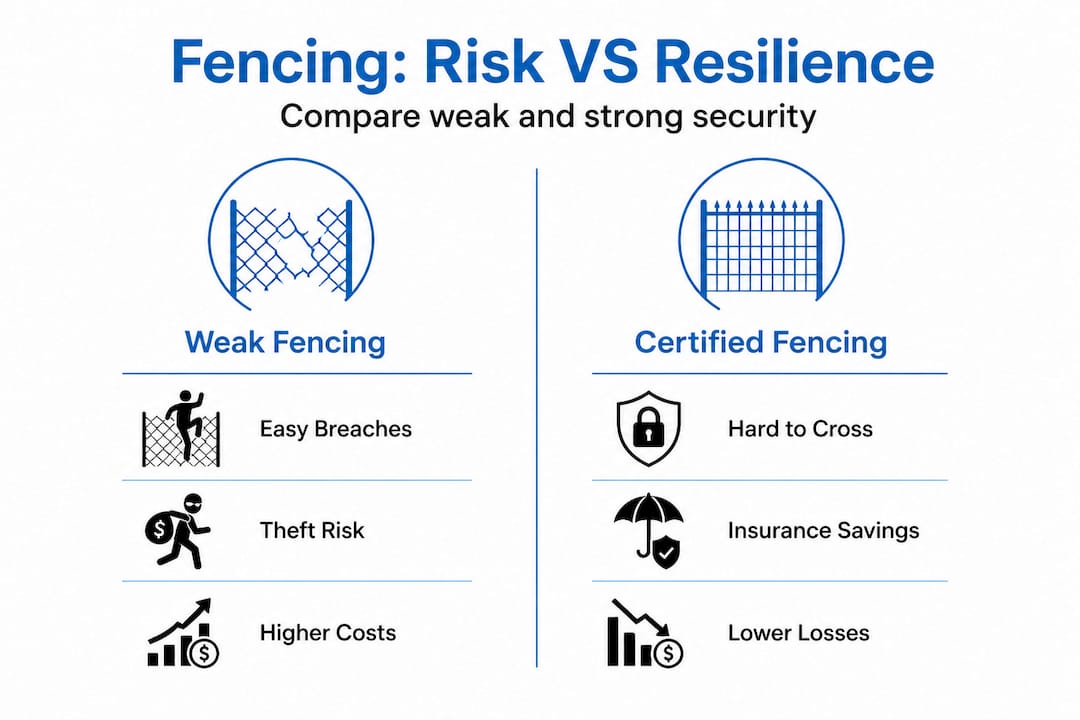
Certified mesh panel and anti-climb fencing, integrated with electronic detection and lighting, are widely recognised as most effective for logistics facilities, with proper certified fencing capable of reducing incidents by up to 50%.
Does insurance in South Africa require certified fencing for logistics facilities?
Many insurers offer lower rates or require up-to-date, certified fencing and layered security systems for logistics operators to qualify for cover and reduce risk exposure.
How much can fencing reduce cargo theft losses?
Correctly specified and professionally installed certified fencing can cut incidents by up to 50%, delivering substantial reductions in financial and operational loss over time.
Can electric fencing be relied on during load shedding?
Electric fencing alone is vulnerable during power outages and should never serve as the sole perimeter solution, given that load shedding bypasses electric perimeter systems entirely during outage windows.
What is the ROI on integrated fencing and security systems?
Fully integrated security systems that combine rated physical fencing with electronic detection and access control can pay for themselves in 1 to 2 years by preventing high-value cargo theft and reducing insurance premiums.
Recommended
- Security Rating in Fencing – Why It Matters in South Africa – Jumalu Fencing
- Commercial Security Fencing Benefits: Complete Guide South Africa – Jumalu Fencing
- Perimeter Fencing – How It Elevates Industrial Security – Jumalu Fencing
- Fencing and Urban Security – Impact on South African Spaces – Jumalu Fencing