{ “@type”: “FAQPage”, “@context”: “https://schema.org”, “mainEntity”: [ { “name”: “What is the cheapest fence option for a farm?”, “@type”: “Question”, “acceptedAnswer”: { “text”: “Barbed wire and plain high-tensile strand fencing generally cost the least per metre among farm fencing types, since they use fewer materials and fewer posts than mesh or pipe construction. They suit large, low-pressure perimeters better than mixed stock or security applications.”, “@type”: “Answer” } }, { “name”: “What type of fence is best for a farm?”, “@type”: “Question”, “acceptedAnswer”: { “text”: “The best fence depends on the job: woven wire or mesh suits mixed stock containment, electrified strands suit predator deterrence, and clear-view mesh suits farmyard security where visibility also matters. Matching the fence to the specific animal and risk, as outlined in the VRS complete guide to farm fencing, works better than defaulting to one style for the whole property.”, “@type”: “Answer” } }, { “name”: “What are some good ideas for a farm fence?”, “@type”: “Question”, “acceptedAnswer”: { “text”: “Post-and-rail suits boundaries and light stock, woven mesh suits mixed herds, electrified lines add predator protection, and clear-view mesh like ClamberPrufe fits farmyards needing both visibility and security. Combining two styles, such as mesh with an electrified top strand, often covers more ground than any single option alone.”, “@type”: “Answer” } }, { “name”: “What are the latest fencing trends?”, “@type”: “Question”, “acceptedAnswer”: { “text”: “Clear-view mesh systems with anti-climb and anti-cut properties have gained ground on farms that need both surveillance visibility and robust security, particularly around equipment yards and high-value storage. Electrified retrofits, including aprons and offset trip wires added to existing fences, are also a growing practical trend for predator deterrence.”, “@type”: “Answer” } } ] }
For stock containment, woven wire or high-tensile fencing does the job; for goats, closer-spaced netting prevents escapes; for predator control, electrified strands with a buried apron work best; for a boundary with curb appeal, post-and-rail or clear-view mesh wins. This guide walks through seven fence types, how to size posts and strands, and when a professional installation makes more sense than a weekend project.
TL;DR:
- Cattle generally need fencing about 1,200 mm high with five strands, while game and predator barriers require greater height and more strands.
- Post spacing can range from 12 metres on intensive or soft ground to 20 metres on extensive grazing land, with droppers adjusted accordingly.
- Treat adjoining paddocks as sharing one internal fence; counting that line twice can overstate material needs by around 25% in estimates.
- Where predators pose a risk, add electrification to a physical barrier; larger carnivores may require more strands and active monitoring.
Table of Contents
- 1. Fence styles and where each one earns its place
- 2. How do you choose the right fence for your farm?
- 3. Materials, construction basics, and routine maintenance
- 4. What does research say about predator-proof and electrified fencing?
- 5. Comparing ClamberPrufe variations for different farm security needs
- 6. What matters when installing clear-view fencing on a farm
- 7. Gate options that integrate with mesh and mining fencing
- 8. How do you keep high-security clear-view fencing lasting?
- 9. What the trade-offs actually come down to
- 10. Jumalu Fencing: a professional option for security-sensitive farmyards
- FAQ
- Sources
1. Fence styles and where each one earns its place
Every farm fence trades off cost, maintenance, and the specific job it needs to do. Matching the style to the task upfront saves money and prevents the kind of failures that let animals out or predators in.
Post-and-rail and split-rail fences suit boundaries and low-pressure stock like horses in calm paddocks. They look clean and signal property lines well, though they offer limited resistance against a determined predator or a goat that wants through a gap.
Woven wire or mesh fencing, often sold under names like Bonnox or Veldspan in southern Africa, remains the standard for mixed stock operations. The tight grid pattern contains sheep, goats, and cattle in the same enclosure without the gaps that plain strand fencing leaves open.
Barbed wire and high-tensile strand fences cover large perimeters economically. High-tensile wire holds tension over long spans with fewer posts, which cuts material costs on big cattle runs, though it needs careful strainer post placement at corners and gate ends.
Electric fencing, whether permanent or portable, handles predator deterrence and flexible rotational grazing. A properly built electrified line can prevent predation in lambing camps and in some cases outperforms a conventional jackal-proof fence built without electrification, according to extension guidance on managing jackal predation.
Pipe and pipe-and-wire fences suit heavy-duty corralling where cattle lean, push, or rub against the line daily. Steel pipe construction needs almost no maintenance once installed, which makes it a strong fit for handling yards and loading areas.
Clear-view mesh and welded mesh fencing, the style behind systems like ClamberPrufe clear view fencing, gives farmyards and high-value storage areas both visibility and resistance to cutting or climbing. It suits the parts of a property where you want to see what is happening on the other side while still keeping intruders or stray animals out.
Rustic and hybrid options fit small hobby farms on tighter budgets. A post-and-wire mix, combining timber posts with a few strands of high-tensile wire, handles light stock pressure at a fraction of the cost of full mesh panels.
A few points to weigh before settling on a style:
- Mixed stock operations generally need mesh rather than strand wire, since goats and sheep find gaps in widely spaced wires.
- Predator-prone areas benefit from electrification layered onto a physical barrier rather than relying on wire alone.
- High-value or high-visibility areas, like farmyards and equipment stores, suit clear-view mesh more than solid paneling.
2. How do you choose the right fence for your farm?
Start with the primary job the fence needs to do: contain stock, exclude predators, secure a yard, or simply mark a boundary. That one decision narrows the shortlist fast.
- Identify the animal. Cattle generally need a fence around 1,200 mm high with five strands, while game and predator-proof fencing requires greater height and considerably more strands, per the VRS complete guide to farm fencing.
- Check the terrain and shared lines. When subdividing camps, a shared internal fence is built once, not doubled for both adjoining paddocks. Treating it as a single shared line rather than two separate perimeters avoids overestimating material needs by around 25%, according to a fencing calculator and standards reference.
- Plan gates and access widths. Vehicle and equipment access dictates gate sizing well before the rest of the fence line goes up.
- Weigh upfront cost against lifecycle cost. Cheaper wire options often demand more frequent tensioning and repair, so the lower sticker price does not always mean the lower total cost.
Post spacing follows the same logic as animal pressure: roughly 12 metres apart on intensive stock or soft soil with two to three droppers between posts, 16 metres under average conditions with three to four droppers, and up to 20 metres on extensive grazing land with four to five droppers, per the same fencing calculator reference.
Pro Tip: Map your gate locations before ordering materials. Moving a gate after the fence line is set wastes both posts and labour.
3. Materials, construction basics, and routine maintenance
Material choice determines how long a fence lasts and how much attention it needs afterward.
Timber posts cost less upfront and suit most farm settings, though they weather faster in wet soil. Steel posts cost more initially but outlast timber by a wide margin in corrosive or high-moisture ground. Wire types range from plain and barbed strand to high-tensile and woven mesh, each suited to a different mix of stock and budget. Galvanised coatings resist rust in most inland conditions, while PVC-coated finishes hold up better in coastal or humid areas where salt air accelerates corrosion. Our galvanized fencing guide breaks down which coating suits which climate.
Strainer and corner posts carry the bulk of the tension load on any wire fence, so they need to be set deeper and braced more firmly than line posts.
A short maintenance routine keeps most fences functional for years:
- Check wire tension each season, since temperature swings loosen strands over time.
- Clear vegetation along the line to prevent rot at the base of timber posts and shorts in electrified wires.
- Inspect gate hardware and hinges for wear before it causes a gate to sag or jam.
A fence line clearing guide covers vegetation control in more depth, and our own fencing maintenance checklist lays out a seasonal inspection schedule.
4. What does research say about predator-proof and electrified fencing?
Electrified lambing camp fences, when built and maintained correctly, can prevent predation outright and in some documented cases work better than standard jackal-proof fencing, per the UFS extension guidance. Regulatory specifications for game and predator fencing vary by species, with larger carnivores typically requiring more wire strands and active electrification with monitoring, according to NCNCA fencing specifications.
Effectiveness depends on species risk, terrain, and cooperative maintenance with neighbours rather than any single fence design.
For farmyards and equipment areas where visibility matters as much as containment, a clear view fencing guide and industrial fencing requirements overview outline the specification and compliance details that apply to electrified and high-security lines.
5. Comparing ClamberPrufe variations for different farm security needs
The ClamberPrufe family covers a range of security levels, so the right variation depends on what the fence needs to deter and how much visibility the site requires.
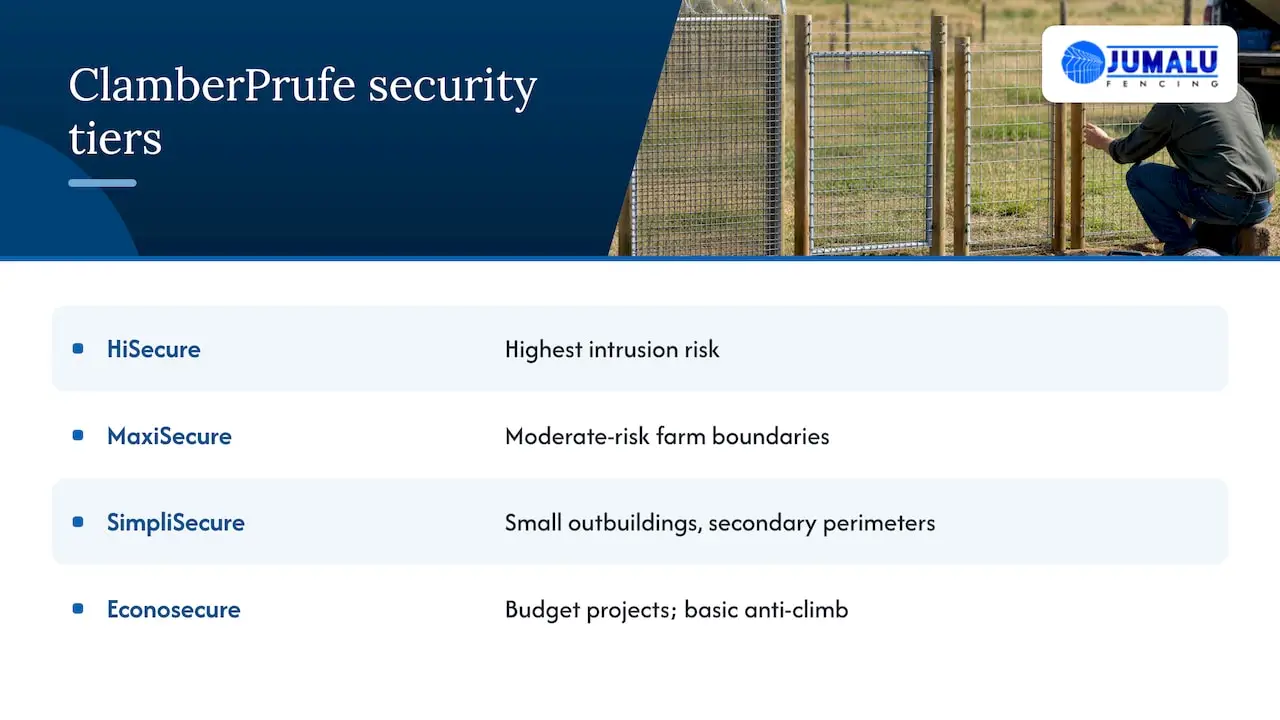
ClamberPrufe HiSecure targets properties facing the highest intrusion risk, pairing anti-climb and anti-cut mesh with reinforced framing suited to farmyards storing high-value equipment or livestock. ClamberPrufe MaxiSecure sits a step below, offering robust protection for working farm boundaries where security matters but the threat level is moderate. ClamberPrufe SimpliSecure suits smaller outbuildings or secondary perimeters where a straightforward clear-view barrier is enough. ClamberPrufe Econosecure fits budget-conscious projects, such as fencing a secondary paddock or storage yard, where clear visibility and basic anti-climb protection matter more than the highest security tier.
Each variation keeps the unobstructed sightlines that make clear-view mesh useful for farm surveillance, while scaling the gauge and reinforcement to match the security requirement. Choosing between them comes down to what sits behind the fence: a workshop full of machinery calls for HiSecure or MaxiSecure, while a grazing paddock with a lower risk profile suits SimpliSecure or Econosecure. Full specifications for each tier are listed on our ClamberPrufe clear view fencing pages.
6. What matters when installing clear-view fencing on a farm
Clear-view mesh installation on a working farm has a few requirements that differ from a standard residential job. Ground conditions vary widely across a property, so post depth and bracing often need to change from one section of the perimeter to the next, particularly where soil turns sandy or rocky.
Long, exposed fence runs across open farmland also face greater wind load than a suburban boundary, which means strainer posts and corner bracing need to be sized for the span rather than installed to a single standard spec. Farms frequently run fencing near existing stock enclosures, irrigation lines, or vehicle tracks, so planning the route around those obstacles before installation begins avoids costly rework.
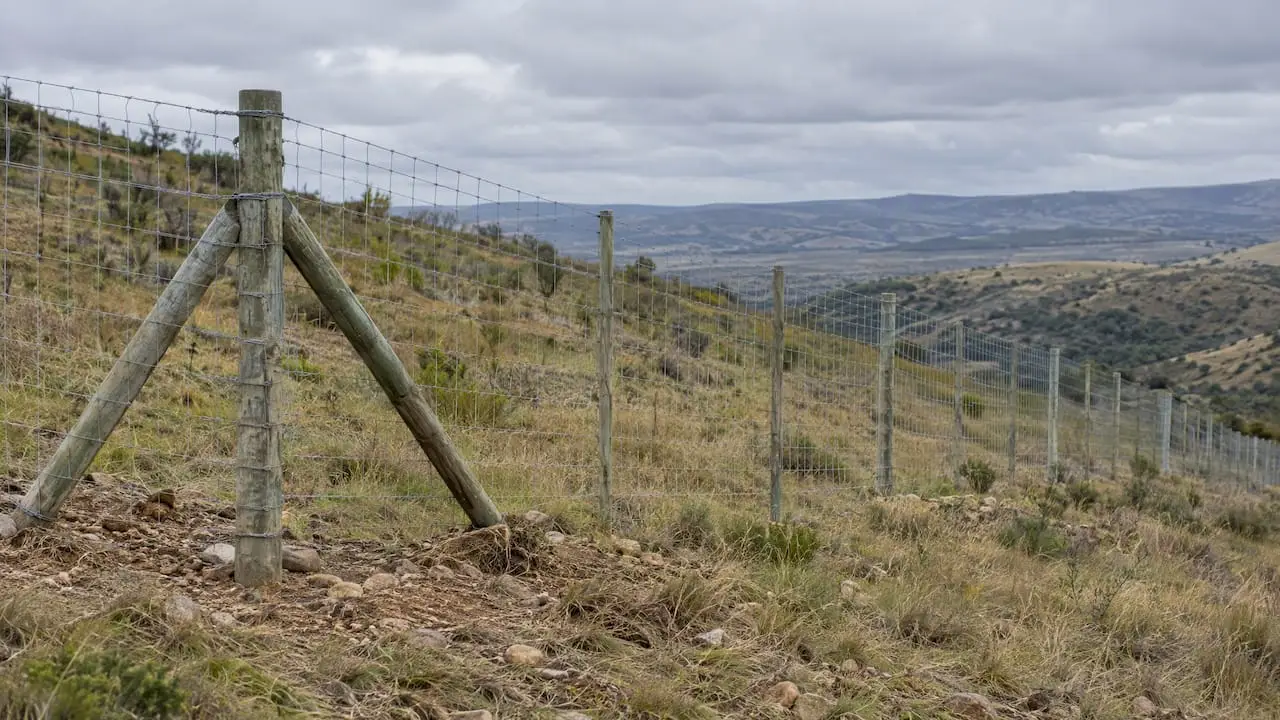
Professional installation accounts for all of this at the outset: correct post depth for the specific soil type, properly tensioned mesh panels that resist sagging over long spans, and finishes matched to the local climate. A rushed or improvised installation tends to show its weaknesses within the first year, usually at the corners and gate posts where tension concentrates. Our clear view fencing guide covers the specification details that go into a properly engineered run.
7. Gate options that integrate with mesh and mining fencing
A security fence is only as strong as its weakest gate, so matching gate type to the fencing style around it matters as much as the fence line itself. Custom gates manufactured to pair with clear-view mesh keep the same anti-climb and anti-cut properties across the full perimeter, rather than leaving a visibly weaker entry point.
Gate width needs to reflect actual vehicle and equipment traffic. A single farm gate sized for a bakkie will not accommodate a tractor or a livestock trailer, so measuring the widest vehicle that will regularly pass through is worth doing before ordering. General gate width standards offer a useful starting reference point that can be adapted to farm equipment dimensions.
For sites combining mesh fencing with mining-grade perimeter sections, say a processing yard bordered by both a farmyard mesh fence and a heavier mining fence line, gates need hardware rated for the higher traffic and loads typical of mining access points. Our gate manufacture service covers custom sizing and finish matching so the gate does not become the gap in an otherwise secure line.
8. How do you keep high-security clear-view fencing lasting?
High-security clear-view fencing holds up well over time, but a few routine checks keep it performing at its intended level. Tension in the mesh panels should be checked each season, since long runs under wind load and temperature swings gradually loosen fastenings at the posts.
Coating condition deserves attention too, particularly in coastal or humid areas where salt air accelerates corrosion faster than inland sites. A quick visual check for coating wear at welds and cut edges catches early corrosion before it spreads. Vegetation growing against the mesh traps moisture and accelerates rust, so clearing growth along the line each season protects both the coating and the wire itself.
Gate hinges and locking hardware see the most mechanical wear of any part of the system and are worth inspecting more often than the fence line itself. A fencing maintenance checklist lays out a seasonal schedule that covers tension checks, coating inspection, and hardware care in one routine.
9. What the trade-offs actually come down to
Cheaper fencing costs less now and more later in repairs. Predator-proofing and long, high-tension runs reward a professional quote over a weekend build. Planning gate placement and shared fence lines first is what actually saves money.
— Jaline
10. Jumalu Fencing: a professional option for security-sensitive farmyards
For farmyards, equipment stores, or boundary sections where security and visibility both matter, ClamberPrufe clear view fencing combines anti-climb and anti-cut mesh with a galvanized or PVC-coated finish built for coastal and humid conditions.
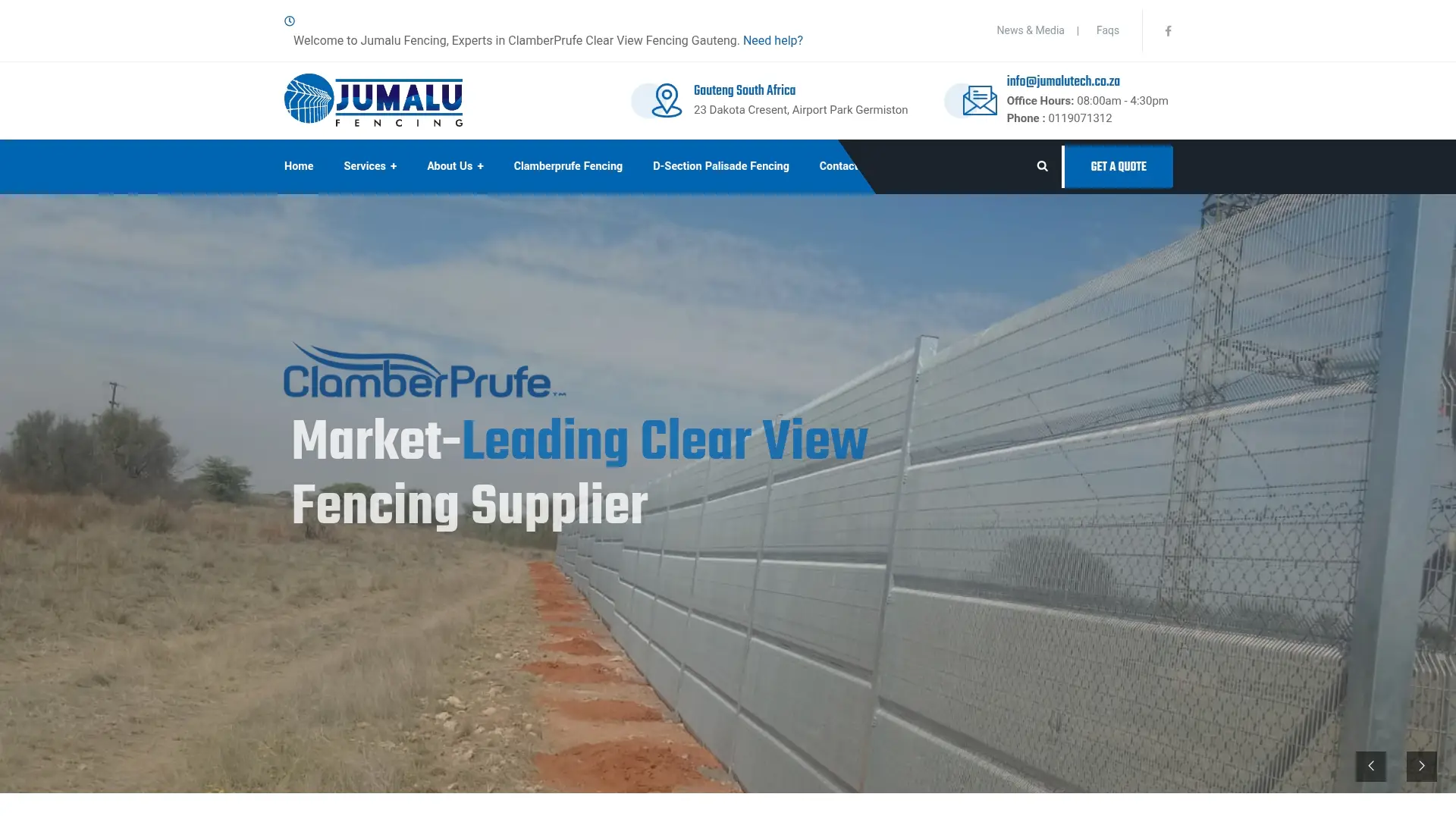
A site assessment lets us match post depth, bracing, and finish to your specific terrain before we quote the job, so the fence you get is sized for the span and soil it actually sits on. Browse our ClamberPrufe fencing options or request a quote through our service pages to get started.
FAQ
What is the cheapest fence option for a farm?
Barbed wire and plain high-tensile strand fencing generally cost the least per metre among farm fencing types, since they use fewer materials and fewer posts than mesh or pipe construction. They suit large, low-pressure perimeters better than mixed stock or security applications.
What type of fence is best for a farm?
The best fence depends on the job: woven wire or mesh suits mixed stock containment, electrified strands suit predator deterrence, and clear-view mesh suits farmyard security where visibility also matters. Matching the fence to the specific animal and risk, as outlined in the VRS complete guide to farm fencing, works better than defaulting to one style for the whole property.
What are some good ideas for a farm fence?
Post-and-rail suits boundaries and light stock, woven mesh suits mixed herds, electrified lines add predator protection, and clear-view mesh like ClamberPrufe fits farmyards needing both visibility and security. Combining two styles, such as mesh with an electrified top strand, often covers more ground than any single option alone.
What are the latest fencing trends?
Clear-view mesh systems with anti-climb and anti-cut properties have gained ground on farms that need both surveillance visibility and robust security, particularly around equipment yards and high-value storage. Electrified retrofits, including aprons and offset trip wires added to existing fences, are also a growing practical trend for predator deterrence.
Sources
- Managing predation by black‑backed jackal (extension guidance)
- VRS complete guide to farm fencing
- Fencing calculator and standards reference (South Africa)
- NCNCA fencing specifications (regulatory guidance)