{ “@graph”: [ { “@type”: “Article”, “image”: { “url”: “https://media.babylovegrowth.ai/blog-images/organization-6538/1793723571974_Freestanding-gabion-boundary-with-angular-stone-fill.jpeg”, “@type”: “ImageObject”, “caption”: “Freestanding gabion boundary with angular stone fill” }, “author”: { “url”: “https://jumalutech.co.za”, “name”: “Jumalu Fencing”, “@type”: “Organization” }, “headline”: “Gabion Fence Ideas: Designs, Fill Choices and Security Limits”, “publisher”: { “url”: “https://jumalutech.co.za”, “name”: “Jumalu Fencing”, “@type”: “Organization” }, “inLanguage”: “en-US”, “description”: “Gabion fence ideas for boundaries, slopes, seating and planting, with fill, drainage and stability advice, and where clear view security fencing is the better fit.”, “dateModified”: “2026-11-05T00:00:00.000Z”, “datePublished”: “2026-11-05T00:00:00.000Z” }, { “@type”: “BreadcrumbList”, “itemListElement”: [ { “item”: “https://jumalutech.co.za”, “name”: “Jumalu Fencing”, “@type”: “ListItem”, “position”: 1 }, { “name”: “Gabion Fence Ideas: Designs, Fill Choices and Security Limits”, “@type”: “ListItem”, “position”: 2 } ] } ], “@context”: “https://schema.org” }
{ “@type”: “FAQPage”, “@context”: “https://schema.org”, “mainEntity”: [ { “name”: “What is a gabion’s weakness?”, “@type”: “Question”, “acceptedAnswer”: { “text”: “The main weakness for boundary use is climbability. Gabion walls are easier to climb than smooth stone walls or other perimeter fencing, so they suit garden and landscape roles better than perimeter security. Poor stone grading and blocked drainage can also affect long-term stability.”, “@type”: “Answer” } }, { “name”: “What is the cheapest way to fill a gabion?”, “@type”: “Question”, “acceptedAnswer”: { “text”: “Crushed concrete is generally the cheapest fill, provided it is clean, non-degradable and correctly graded for the mesh opening, as set out in technical guidance. For visible walls, a common approach is to place attractive stone on the outer faces and economical filler in the core.”, “@type”: “Answer” } }, { “name”: “Can a gabion fence be combined with timber?”, “@type”: “Question”, “acceptedAnswer”: { “text”: “Yes. Gabion columns alternating with horizontal wooden panels give a boundary that offers privacy without feeling heavy. The timber warms the industrial look of the wire and stone, and a protective finish keeps it consistent over time.”, “@type”: “Answer” } }, { “name”: “Do gabion walls need engineering or permits?”, “@type”: “Question”, “acceptedAnswer”: { “text”: “Tall walls do. One guide states that walls over 1.5 metres require engineering, and permit rules differ by height, retaining function and jurisdiction. Confirm requirements with your local building authority before construction.”, “@type”: “Answer” } }, { “name”: “What should I use where the boundary must also be secure?”, “@type”: “Question”, “acceptedAnswer”: { “text”: “Specify a purpose-built anti-climb, anti-cut barrier at the property line and keep gabion features inside it. Our ClamberPrufe clear view system is designed for this role, and our team can advise on the configuration that suits your site.”, “@type”: “Answer” } } ] }
A gabion fence is a wire basket structure filled with stone or similar material, and the strongest designs use it for what it does well: marking a boundary, adding texture and privacy, retaining a slope, or defining an outdoor living area. Where the line must also deter intruders, a gabion works best as a landscape feature set in front of, or beside, a purpose-built security barrier. This guide sets out the design ideas that work, the fill and construction decisions that determine how they last, and how we advise clients to combine decorative walls with high-security clear view fencing.
TL;DR
- Gabions suit garden boundaries, terraces, planters, seating bases and feature columns. Pair them with timber slats or planting for a softer finish.
- Stone choice sets the character: basalt reads dark and modern, limestone and dolomite read warm, and river pebbles read natural.
- Fill the visible faces with attractive stone and the core with cheaper material, and keep the grading matched to the mesh opening.
- A rough stone face can be climbed more easily than a smooth wall, so gabions alone are not the answer where security is the priority.
- For perimeters that need anti-climb and anti-cut performance with open sightlines, our ClamberPrufe clear view system is built for that purpose.
Table of Contents
- Where gabion fences make sense
- Boundary and privacy designs
- Slope and level-change designs
- Seating, planters and garden features
- Choosing stone and fill
- Stability, drainage and durability
- The security question: what gabions do not do
- Combining gabion design with high-security fencing
- Perspective
- Choosing a ClamberPrufe specification
- Work with Jumalu Fencing
- FAQ
- Sources
Where gabion fences make sense
Gabions began in civil engineering, where they were used to stabilise slopes and prevent erosion, and they have since moved into domestic landscaping for aesthetic and practical purposes. That dual heritage explains their range. A gabion fence can provide privacy and mark boundaries, retain slopes, incorporate seating or define an outdoor living area, and the same basket system can do any of these jobs with a different fill and finish.
The ideas below are grouped by the problem each one solves, because the right design depends first on what the wall is for.
Boundary and privacy designs
Freestanding gabion screen
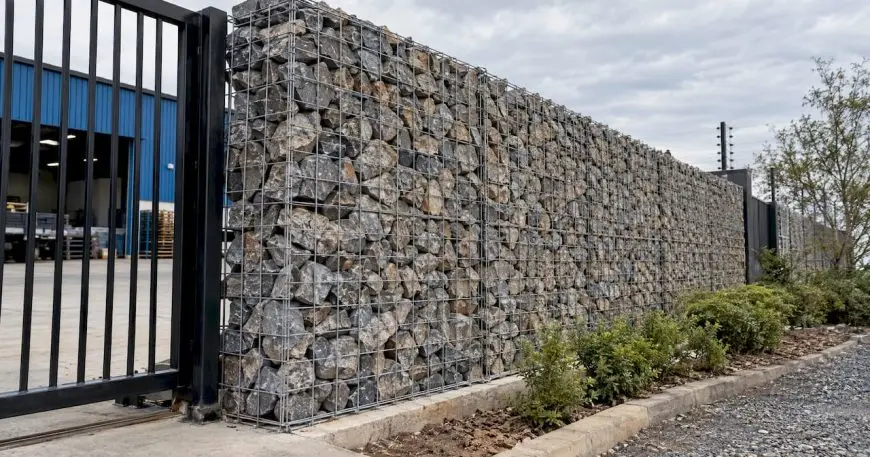
The simplest design is a freestanding row of baskets built up to the height needed for privacy. Because the stone face is dense, it blocks sightlines and absorbs noise better than an open panel. Treat the stone face as a deliberate architectural panel rather than rubble: one design guide recommends uniform angular fill to create a clean, dense texture. Consistent stone size, placed with care, is what separates a considered boundary from a pile of rocks in a cage.
Gabion columns with timber panels
Solid walls can feel heavy along a long boundary. Alternating gabion columns with horizontal wooden panels gives a strong, elegant boundary that offers privacy without feeling heavy or enclosed. The columns also act as structural anchors and as natural locations for gate posts, lighting or house numbers. Wood slats warm the industrial quality of the framework, and a protective finish keeps them looking intentional over time, which is where professional fence staining and painting earns its place in the maintenance plan.
Matching the style of the house
A boundary reads best when it echoes the building behind it. Architectural Digest advises that a privacy fence should complement the home’s style, taking cues from exterior carpentry such as railings, shutters and decking. For a gabion, that means choosing stone colour and any timber or metal capping to match those details: dark basalt with black window frames, or warm limestone with natural cedar.
Gabion with a clear view fence behind it
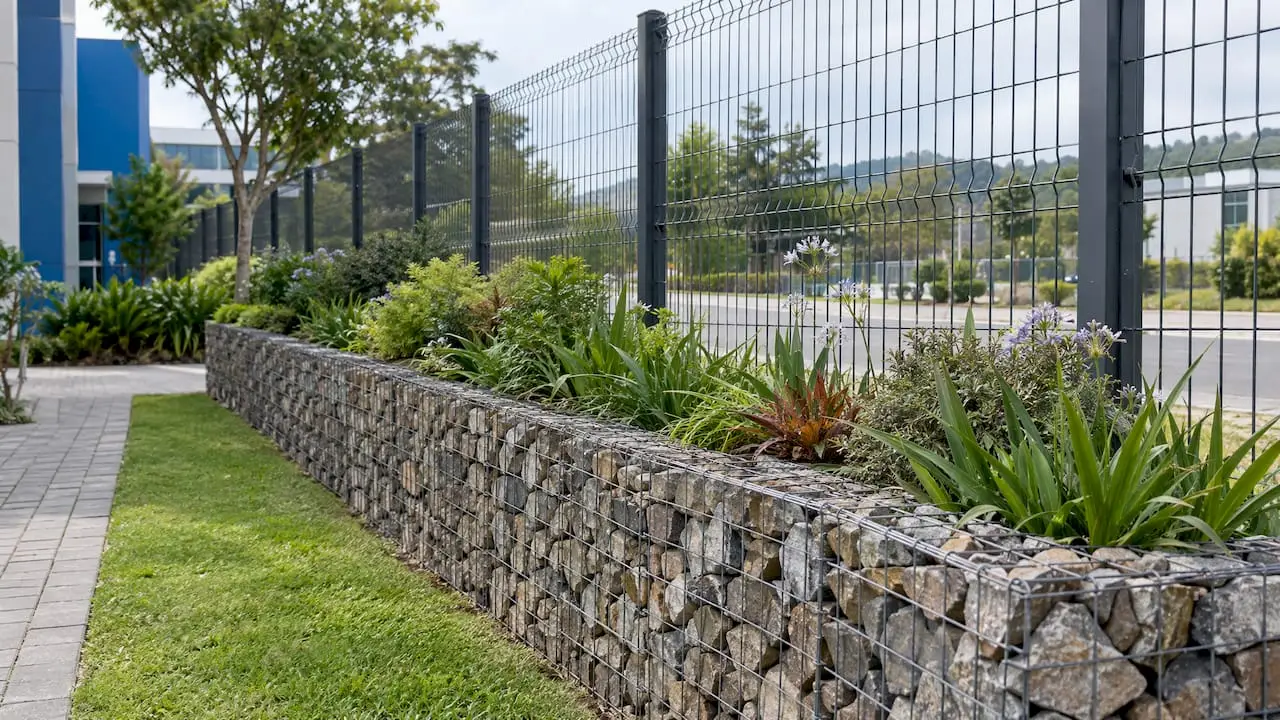
This is the combination we recommend most often for properties with both a design brief and a security brief. A low or medium-height gabion wall or planter bed forms the visible garden edge, while a clear view security fence behind or alongside it carries the anti-climb and anti-cut function. The owner gets texture and planting at street level, and the site keeps an open line of sight along the perimeter. We return to this approach in the Perspective section below.
Slope and level-change designs
Gabions are at their most natural when they do structural work. For sloping or erosion-prone properties, stepped or curved gabions can serve as retaining walls and terraces. LoveYourLandscape describes gabions retaining a driveway slope and creating a level patio terrace, and notes a Central Texas example using curved, tiered walls to mark grade changes.
A few practical points apply to any retaining design:
- Build on a level, compacted base, with the wall stepped back slightly on each course. One Australian guide specifies a compacted crushed-rock base and a 50 to 100 mm batter per course.
- Use cross-bracing to prevent the baskets from bulging under the weight of the fill.
- Place geotextile behind the wall so soil does not migrate into the stone.
- Have walls over 1.5 metres engineered, according to the same guide.
Seating, planters and garden features
Built-in seating
A low gabion run capped with wood, stone or metal becomes a bench that doubles as an edge to a patio or fire pit. The cap is the part people touch, so material choice matters more here than the stone inside.
Planting pockets and raised beds
Gabions work as statement backdrops for plants. For planted designs, one UK guide suggests building planting pockets or raised beds, lining the pockets with geotextile and filling them with gritty compost and drainage-loving plants such as sempervivums, sedums, thyme and aubrieta. Vines can also soften the framework of a plain wall. Choose plants to suit your own climate and hardiness zone, and finish the scheme with suitable garden and patio accessories that match the stone and timber palette.
Columns, steps, tables and water features
The same baskets can be stacked into entrance columns, steps, side tables or the base of a water feature. These small-scale uses are forgiving, since low heights place little load on the structure and let you experiment with colour and texture before committing to a long boundary.
Choosing stone and fill
Stone is the single largest visual decision. The visible face is what the neighbours, and your guests, will judge.
| Fill | Look | Pairs well with |
|---|---|---|
| Basalt | Dark, modern | Black metalwork, minimalist planting |
| Limestone and dolomite | Warm, light | Natural wood, Mediterranean plants |
| River pebbles | Soft, natural | Informal gardens, water features |
These descriptions follow a guide to gabion stone selection, which also notes that dark or light stones change the look of the wall considerably.
The cheapest way to fill a gabion
A frequent question is how to fill a gabion economically. Crushed concrete is generally the cheapest fill, provided it is non-degradable and free of debris and foreign materials. Its grading must be larger than the mesh opening and no greater than two-thirds of the unit width or 150 mm, whichever is smaller, according to manufacturer technical guidance. Locally sourced or upcycled materials can also make a wall more sustainable than traditional fencing or brickwork.
For larger walls there is a more economical approach that keeps the appearance intact. The visible outer surfaces can be layered with the desired stone while the inner area is filled with a suitable, more affordable filler stone.
Stone size and placement
Cheap fill still needs discipline. A forensic study from TRL found that gabion wall performance depends heavily on the skill of stone placement and the gradation of the fill, and warns against oversized stone that creates large, destabilising voids. Indian design guidelines specify durable stone sized 1.5 to 2.5 times the mesh opening, hand-placed and packed.
Stability, drainage and durability
A gabion wall is porous by design, but that does not mean drainage can be ignored. Engineers at Darda note that long-term integrity depends on keeping drainage paths free of fines and using non-cohesive, well-compacted backfill. Where a wall holds back soil, keep the water path clear behind it.
On durability, galvanised or PVC-coated cages resist corrosion, and cross-bracing helps prevent bulging. In coastal or humid regions, the coating specification is worth settling before anything else, because the wire is the part of the structure that cannot easily be replaced once the stone is in.
Some situations need a professional before any basket is filled: taller walls, gates built into the structure, nearby driveways and unstable ground. Engage a qualified engineer or your local building authority, as permit requirements vary by wall height, retaining function and jurisdiction.
The security question: what gabions do not do
The People Also Ask box for this keyword asks what the weakness of a gabion is. The answer matters for anyone choosing a boundary. Gabion walls are easier to climb than smooth stone walls or other forms of perimeter fencing, because a rough, stepped stone face offers footholds. For this reason, they are best placed as landscape features rather than as the only line of defence on a perimeter where security is a concern.
Vegetation raises a related point. The UK’s National Protective Security Authority advises that perimeter lines must be managed so that vegetation does not provide climbing aids or concealment, whatever the fence type. A vine-covered gabion planted tight against a security line should be planned with that in mind.
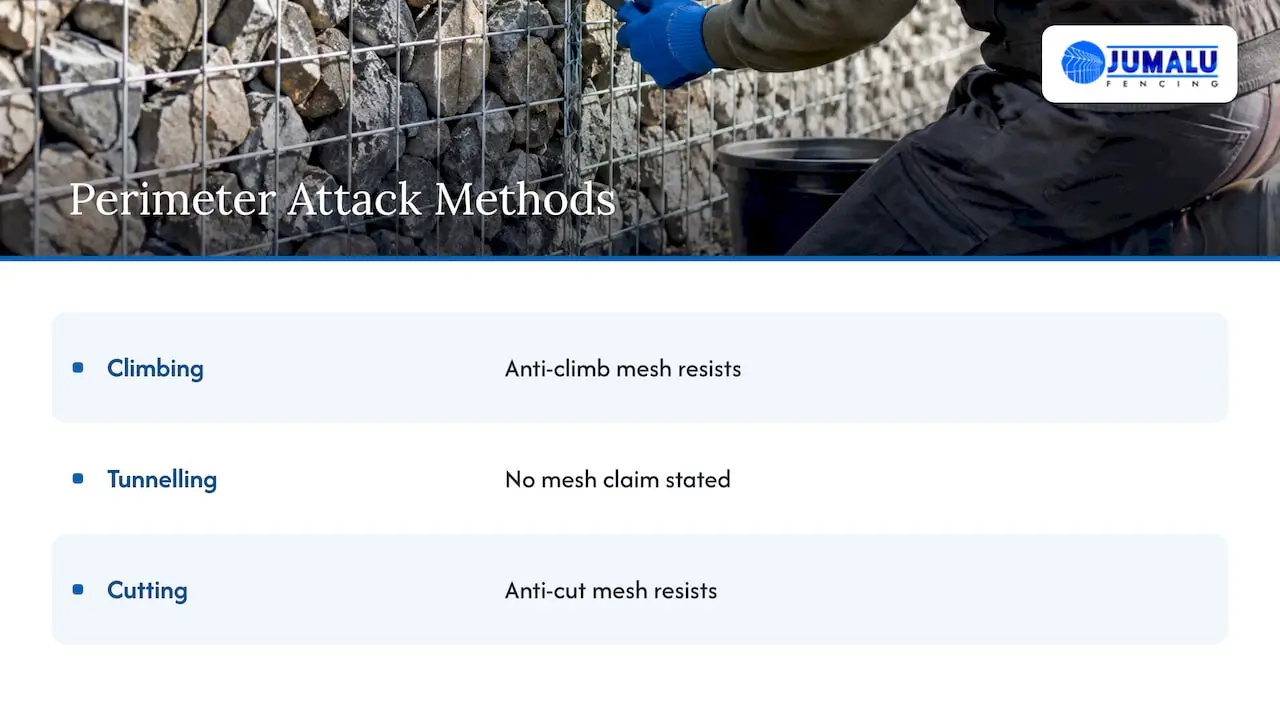
On defeat methods, the RCMP’s fencing guide says fence height can increase climbing difficulty and delay, and that design should consider likely attacks such as climbing, tunnelling and cutting through the fence fabric. Those three methods are exactly what an anti-climb, anti-cut mesh is engineered to resist.
Combining gabion design with high-security fencing
For commercial, industrial, mining and high-value residential sites, the practical approach is to divide the work. Let the security fence do the security job, and let gabions, planting and timber do the design job.
- Define the threat and the sightlines. Decide whether the site needs clear observation across the boundary, which is typical for warehouses, plants and estates.
- Set the security line first. Specify an anti-climb, anti-cut barrier at the true property boundary.
- Layer the landscape inside it. Place gabion planters, seating and feature columns on the inside, keeping vegetation and climbable surfaces away from the fence line.
- Plan gates and access together. Gate posts, vehicle access and pedestrian entries should be specified with the fence, not added afterwards.
If you want more on how style and protection can coexist, our article on aesthetic security fencing options covers the design side in detail, and our secure perimeter planning guide sets out the order of decisions for a new boundary. For delivery, our fencing installation process explains what happens from site survey to handover.
Perspective
A gabion is a good landscape element and a poor security barrier, and we think owners are best served when the two roles are kept apart. Over the years we have seen boundary designs where the decorative wall was asked to do everything, and the result was a perimeter that looked considered but offered intruders a stepped, climbable face.
Our approach is to specify the security line first. The ClamberPrufe system is designed with anti-climb and anti-cut properties and an open, clear view profile, so that guards, cameras and owners keep an unobstructed line of sight along the boundary. The galvanised or PVC-coated finish is intended to give durability in harsh weather, including coastal and humid conditions.
Once that line is set, the garden can be as expressive as the owner wishes: basalt planters, limestone seating, timber screens and planting on the inside. Security and aesthetics are not competing requirements. They are two layers of one design, and the strongest properties are those where both were planned together.
Jaline
Choosing a ClamberPrufe specification
The ClamberPrufe range is offered in several configurations, so the specification can be matched to the risk and the budget of the site. The range includes ClamberPrufe HiSecure, MaxiSecure, SimpliSecure and EconoSecure. Each is a clear view system with anti-climb and anti-cut properties, and the choice between them depends on the level of protection the site requires. Our team advises on the appropriate configuration during the site assessment.
Work with Jumalu Fencing
Jumalu Fencing manufactures, supplies and installs high-security clear view fencing across South Africa and supplies export and mining clients. Our scope includes the ClamberPrufe system, mesh fencing, razor wire mesh panels, gates and D-section palisade fencing, with galvanised or PVC-coated finishes and financing options for fencing solutions.
If you are planning a boundary that must combine appearance with proven deterrence, review the ClamberPrufe clear view fencing range and contact us with your site details.
For gates, mesh and mining applications, see our services page.
FAQ
What is a gabion’s weakness?
The main weakness for boundary use is climbability. Gabion walls are easier to climb than smooth stone walls or other perimeter fencing, so they suit garden and landscape roles better than perimeter security. Poor stone grading and blocked drainage can also affect long-term stability.
What is the cheapest way to fill a gabion?
Crushed concrete is generally the cheapest fill, provided it is clean, non-degradable and correctly graded for the mesh opening, as set out in technical guidance. For visible walls, a common approach is to place attractive stone on the outer faces and economical filler in the core.
Can a gabion fence be combined with timber?
Yes. Gabion columns alternating with horizontal wooden panels give a boundary that offers privacy without feeling heavy. The timber warms the industrial look of the wire and stone, and a protective finish keeps it consistent over time.
Do gabion walls need engineering or permits?
Tall walls do. One guide states that walls over 1.5 metres require engineering, and permit rules differ by height, retaining function and jurisdiction. Confirm requirements with your local building authority before construction.
What should I use where the boundary must also be secure?
Specify a purpose-built anti-climb, anti-cut barrier at the property line and keep gabion features inside it. Our ClamberPrufe clear view system is designed for this role, and our team can advise on the configuration that suits your site.
Sources
- Gabion walls are the hot new trend replacing garden fences, Woman & Home
- 12 Modern Gabion Fence Ideas for Industrial Garden Privacy, Wild Bloom Spaces
- Gabion Wall Design: Retaining Wall Ideas, Specs & Permits, Hadaa
- 25 Modern Gabion Wall Ideas for Your Garden, DIY Garden
- 61 Privacy Fence Ideas, Architectural Digest
- 8 Creative Ways With a Gabion Wall, LoveYourLandscape
- Gabion Walls: Complete Guide to Costs, Design, and Installation, ADL Landscaping
- Garden Gabion Builds: Wall, Seat, Raised Bed, Garden UK
- What Kinds of Stones Should You Use for Gabions?, Gabiona
- Cladding & Freestanding Walls, technical guidance
- Forensic Examination of Critical Special Geotechnical Measures, TRL
- Guidelines for Design and Installation of Gabion Structures, IRC
- Gabion Wall: Retaining Wall Design & Drainage, Darda
- Security Fences and Gates, NPSA
- GCPSG-009 Security Fencing Considerations Guide, RCMP
- Fence painting and staining services
- Garden and patio accessories