{ “@graph”: [ { “@type”: “Article”, “image”: { “url”: “https://csuxjmfbwmkxiegfpljm.supabase.co/storage/v1/object/public/blog-images/organization-6538/1789850423813_Technician-surveying-fence-and-CCTV-sightline.jpeg”, “@type”: “ImageObject”, “caption”: “Technician surveying fence and CCTV sightline” }, “author”: { “url”: “https://jumalutech.co.za”, “name”: “Jumalu Fencing”, “@type”: “Organization” }, “headline”: “CCTV Sightlines and Permits: Fence Topper Ideas for Facility Managers”, “publisher”: { “url”: “https://jumalutech.co.za”, “name”: “Jumalu Fencing”, “@type”: “Organization” }, “inLanguage”: “en-US”, “description”: “Fence topper ideas for facility managers and property owners: clear-view mesh, razor and spike options, permit checks, site surveys, and realistic budgets.”, “dateModified”: “2026-09-19T20:41:32.154Z”, “datePublished”: “2026-09-19T20:41:32.154Z” }, { “@type”: “BreadcrumbList”, “itemListElement”: [ { “item”: “https://jumalutech.co.za”, “name”: “Jumalu Fencing”, “@type”: “ListItem”, “position”: 1 }, { “item”: “https://jumalutech.co.za/fence-topper-ideas”, “name”: “CCTV Sightlines and Permits: Fence Topper Ideas for Facility Managers”, “@type”: “ListItem”, “position”: 2 } ] } ], “@context”: “https://schema.org” }
{ “@type”: “FAQPage”, “@context”: “https://schema.org”, “mainEntity”: [ { “name”: “Is razor wire legal on a residential fence?”, “@type”: “Question”, “acceptedAnswer”: { “text”: “It depends entirely on your municipality’s zoning rules. Many authorities permit razor and barbed wire in industrial or agricultural zones but restrict or prohibit it on residential boundaries without prior approval, so check your local by-law before ordering material.”, “@type”: “Answer” } }, { “name”: “What is a clear-view fence topper?”, “@type”: “Question”, “acceptedAnswer”: { “text”: “A clear-view topper is a welded mesh anti-climb and anti-cut extension, like Jumalu Fencing’s ClamberPrufe system, that adds security height while keeping the sightline open for CCTV or manned observation. It’s a common choice for commercial and industrial sites that don’t want a solid topper blocking camera coverage.”, “@type”: “Answer” } }, { “name”: “How often should security toppers be inspected?”, “@type”: “Question”, “acceptedAnswer”: { “text”: “Exposed razor wire coils generally need quarterly checks because they’re prone to sagging, corrosion, and tampering. Welded mesh extensions can typically go on a six-month inspection cycle given their more rigid construction.”, “@type”: “Answer” } }, { “name”: “Do I need a permit to install a fence topper?”, “@type”: “Question”, “acceptedAnswer”: { “text”: “In most cases, yes, particularly for razor wire, barbed wire, or increased fence height. Municipal by-laws such as Kouga’s fencing by-law set specific rules on alterations, exemptions, and penalties, so confirming with your local authority before installation avoids costly rework.”, “@type”: “Answer” } }, { “name”: “How much does a ClamberPrufe installation cost?”, “@type”: “Question”, “acceptedAnswer”: { “text”: “Pricing depends on perimeter length, existing fence condition, and the specific ClamberPrufe product line chosen, from Econosecure to MaxiSecure. Current pricing isn’t published, so the accurate figure comes from a site assessment through Jumalu Fencing.”, “@type”: “Answer” } } ] }
The most effective fence topper ideas for security-focused properties are concertina razor coils, flat-wrap razor, D-section palisade extensions, anti-climb spikes, and welded mesh clear-view extensions mounted on steel arms. The right choice depends on your property type, the condition of your existing fence, and local by-laws. For commercial and industrial sites wanting visibility without sacrificing protection, a clear-view system like ClamberPrufe is worth professional evaluation before you commit to a design.
TL;DR:
- Razor coil and flat-wrap razor wire are highly visible deterrents best suited for high-risk commercial or industrial fences, with coil wire requiring secure mounting and tension checks.
- Clear-view welded mesh systems like ClamberPrufe provide effective protection while maintaining sightlines crucial for CCTV monitoring, especially in public-facing properties.
- Coastal and humid environments demand galvanized or PVC-coated finishes, with PVC coatings offering better corrosion resistance in seaside and industrial atmospheres.
- Most municipality by-laws restrict razor and barbed wire on residential fences and near public roads, requiring property owners to obtain permits and comply with local regulations before installation.
- Proper site assessment and professional installation are essential for a secure, durable fence topper, especially when dealing with existing fence conditions and local weather challenges.
Table of Contents
- Top fence topper ideas for security-focused properties
- [Choosing materials and finishes that survive the weather is crucial, and knowing what kind of doors are best for interiors helps understand durable material selection across interior and exterior applications.](#choosing-materials-and-finishes-that-survive-the-weather-is-crucial-and-knowing-what-kind-of-doors-are-best-for-interiorshttpsonedaydoorsandclosetscomblogfeaturedwhat-kind-of-doors-are-best-for-interiors-helps-understand-durable-material-selection-across-interior-and-exterior-applications)
- Do you need a permit for a fence topper?
- Site survey and installer selection
- Maintenance and inspection schedules that actually work
- Aesthetic and decorative fence topper ideas worth knowing
- DIY fence topper options and customization tips
- How climate and weather shape your topper choice
- What a realistic topper budget looks like
- When a topper is enough, and when you need a new fence
- Get a ClamberPrufe site assessment from Jumalu Fencing
- Sources
- FAQ
Top fence topper ideas for security-focused properties
Choosing between fence extension options means weighing deterrence against visibility, cost against longevity, and public perception against raw stopping power. Here are the professional-grade toppers worth putting on your shortlist.
- Concertina/coil razor wire delivers the highest visible deterrence and is common on industrial perimeters, mine boundaries, and high-risk commercial sites. It needs secure mounting posts and periodic tension checks, and its aggressive appearance makes it a poor fit for residential streets or public-facing frontages.
- Flat-wrap razor wire achieves a similar cutting deterrent with a lower visual profile, which suits sites where continuous coverage matters more than height. Installers typically recommend it where planning rules restrict coil-style toppers but still permit razor tape.
- D-section and palisade extensions add rigid, climb-resistant height to an existing steel palisade fence and work well on commercial and municipal boundaries. They resist bending and don’t sag the way wire-based toppers can over time.
- Anti-climb and welded spikes discourage hand-holds on top rails but carry real limitations. Many jurisdictions restrict spike placement near footpaths or public roads, so they suit internal yard divisions and industrial compounds more than street-facing boundaries.
- Welded mesh and clear-view extensions, the category ClamberPrufe from Jumalu Fencing occupies, combine anti-cut mesh with an unobstructed sightline. That matters when a site relies on CCTV or manned observation, since a solid topper creates blind spots a mesh design avoids.
- Mounted steel arms and angled brackets deny handholds and increase effective height without adding excessive bulk, and they’re frequently paired with any of the wire or mesh options above.
- Layered systems, combining a physical topper with detection sensors or CCTV, reduce the risk of a single point of failure. A layered approach works best when the chosen topper preserves sightlines rather than blocking the camera’s field of view.
Pro Tip: If your site already runs CCTV, prioritize a clear-view topper over a solid or coiled design. A camera aimed at a wall of razor coils captures far less useful footage than one with an unobstructed line of sight.
Choosing materials and finishes that survive the weather is crucial, and knowing what kind of doors are best for interiors helps understand durable material selection across interior and exterior applications.
Galvanizing and PVC coating aren’t cosmetic choices. They determine how many years pass before corrosion forces a replacement, especially in coastal, humid, or industrial atmospheres where salt and airborne chemicals accelerate rust.
- Hot-dip galvanizing bonds a zinc layer to steel that sacrifices itself to corrosion, giving strong protection in most inland and moderate climates.
- PVC-coated finishes add a polymer shell over galvanized steel, which resists abrasion and UV degradation better in coastal or high-humidity zones.
- Mismatched fixings cause galvanic corrosion when dissimilar metals touch in the presence of moisture, so brackets, bolts, and arms should match the topper’s base metal and coating.
- Stainless fixings or thicker coatings are worth the extra cost near the coast, around industrial fumes, or on sites where replacement access is difficult.
Finish choice also shapes your inspection schedule. A PVC-coated system in a dry inland climate can go longer between checks than bare galvanized steel on a coastal fence line exposed to salt spray.
Do you need a permit for a fence topper?
Most municipalities regulate fence height, materials, and topper types, and skipping that check is the fastest way to end up removing a topper you just paid to install. Work through these steps before ordering materials:
- Check your local by-law first. The Kouga Municipality fences and fencing by-law is a useful example of how municipalities define fences, set exemptions, and penalize non-compliant alterations, and most local authorities publish something comparable.
- Confirm whether razor or barbed wire is restricted in your zone. Many municipalities permit barbed or razor wire in industrial and agricultural zones but restrict it on residential boundary lines without prior approval.
- Watch for road-facing restrictions. Some municipal frameworks prohibit spike-style barriers near public roads and require electric barriers to sit at specified minimum wall heights with council permission.
- Gather the paperwork. Minor building works forms, a site plan, and in some cases neighbor consent are typical requirements, especially where a shared boundary fence is being made taller or more restrictive.
- Check national building regulations. SANS 10400 governs construction standards broadly, and fence alterations can fall under local authority enforcement tied to that framework.
- Use an installer who manages approvals. A contractor familiar with your municipality’s process can flag restrictions before installation, not after a compliance notice arrives.
Site survey and installer selection
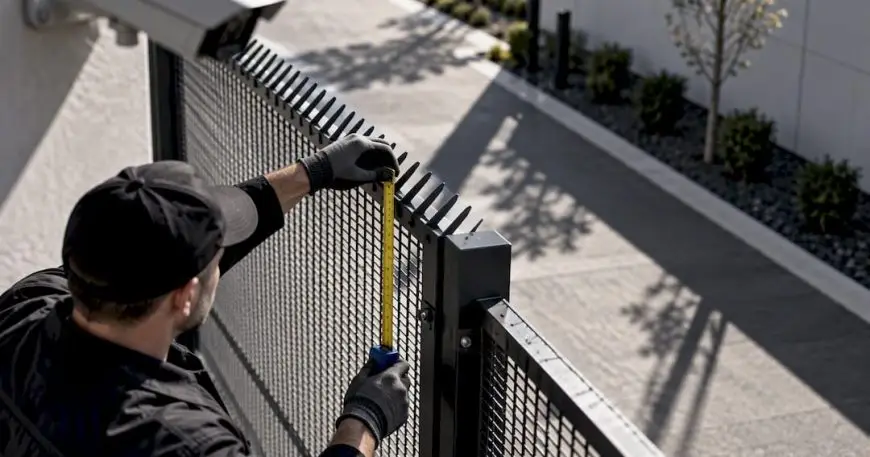
A topper is only as good as its mounting, and mounting starts with an honest look at what you already have. A proper site survey covers the soundness of existing posts and panels, exact perimeter measurement, sightlines where cameras are involved, proximity to pedestrian areas, and the specific points where new fixings will attach.
Mounting typically happens through steel arms or angled brackets bolted to existing posts, though badly corroded or undersized posts sometimes need replacing before any topper goes on. Retrofitting onto a weak fence line wastes money on a topper that won’t hold.
When you request a quote, ask for a written method statement, a clear materials specification including coating type, a maintenance recommendation, and confirmation of installer insurance. Site assessment before costing is standard practice among reputable suppliers, since perimeter length and mounting conditions vary too much for accurate online estimates.
- A quote with no site visit is a red flag, particularly for razor wire installations.
- No method statement for razor wire work suggests the installer hasn’t thought through safety and tensioning.
- No warranty on materials or workmanship should raise questions about long-term accountability.
Pro Tip: Ask any installer quoting on razor wire what PPE and tensioning method they use. A vague answer usually means limited hands-on experience with that specific product.
Maintenance and inspection schedules that actually work
Toppers degrade at different rates depending on exposure and material, so a single inspection calendar doesn’t fit every system. Exposed razor coils benefit from regular checks several times a year since they’re more vulnerable to sagging, corrosion, and tampering. Welded mesh and clear-view panels can generally go on a six-month cycle, given their rigid construction and lower exposure to wind loading.
- Watch for corrosion spots, especially at weld points and fixings.
- Check for sagging wire, loose brackets, or shifted arms after storms.
- Inspect for deliberate cuts or tampering, particularly on street-facing sections.
- Clear vegetation encroachment, which hides damage and gives climbers extra leverage.
Basic tasks like clearing vegetation or tightening visible bolts can be handled in-house. Anything involving re-tensioning razor wire, replacing corroded sections, or repositioning mounting arms calls for a professional. A maintenance checklist and a signed maintenance contract with dated records also matter more than most property owners expect, particularly for insurance claims after an attempted breach.
Aesthetic and decorative fence topper ideas worth knowing
Security toppers dominate this guide because that’s what protects a perimeter, but many commercial and residential clients still want a fence line that looks presentable to the street. Decorative accents like wrought iron finials, planter boxes mounted along lower rail sections, integrated lighting fixtures, and lattice inserts can soften the appearance of a security fence without compromising the topper that does the actual protective work.
The practical approach is layering: keep the anti-climb or anti-cut topper as the functional layer, then add decorative elements below or around it rather than instead of it. A wrought iron accent panel on a gate, for instance, can coexist with a mesh clear-view extension above it. Lighting fixed to fence posts improves both curb appeal and after-dark visibility, which supports security rather than working against it.
Clear-view systems have an advantage here that solid toppers don’t: because the mesh preserves sightlines, the fence reads as open and maintained rather than fortress-like, even while it’s doing serious anti-climb work. Properties balancing a public-facing image with real security requirements, retail parks, office campuses, and schools tend to favor this combination over heavier industrial-style toppers. If aesthetics matter as much as protection on your site, it’s worth reviewing aesthetic security fencing options that keep both goals in view rather than treating them as opposites.
DIY fence topper options and customization tips
Some fence extension options are within reach of a competent property owner, and some genuinely aren’t. Bolting on a decorative cap, adding a lattice extension for privacy, or fitting non-lethal deterrent strips are reasonable DIY projects with basic tools and a weekend.
Razor wire, concertina coils, and welded mesh clear-view systems are a different category entirely. These require correct tensioning, load-rated mounting arms, and often specific PPE to install safely, and a poorly tensioned coil is both a liability and a weaker deterrent than a professionally fitted one. Getting the mounting wrong on a palisade extension can also void a fence’s structural warranty or, worse, create a hazard that falls back on the property owner if someone is injured.
If you’re customizing a lower-risk topper yourself, a few habits keep the project from becoming a repeat job. Match your bracket material to your fence’s existing coating to avoid galvanic corrosion between dissimilar metals. Measure your perimeter twice before ordering material, since underestimating run length is the most common amateur mistake. And check your municipal by-law before you start, not after, since retrofitting a non-compliant topper to meet code costs more than getting it right the first time.
For anything involving anti-cut mesh, razor wire, or spike systems, treat it as licensed installer territory rather than a DIY weekend. The difference between anti-climb terminology and actual anti-climb performance is worth understanding before you buy materials off a shelf expecting professional-grade resistance.
How climate and weather shape your topper choice
Coastal properties face the harshest conditions any fence topper will encounter. Salt spray accelerates corrosion on bare galvanized steel far faster than it does inland, which is why PVC-coated systems earn their higher price tag in beachfront and harbor-adjacent installations.
Humid subtropical regions bring a different challenge: consistent moisture without necessarily the salt load, which still shortens the life of unprotected fixings and encourages rust at weld points long before the main structure fails. Industrial zones add airborne chemical exposure into the mix, meaning a fence topper near a chemical plant or heavy manufacturing site may corrode faster than an identical product a few kilometers away in a residential suburb.
Wind load matters too, particularly for taller extensions like palisade toppers or mounted arms carrying mesh panels. A site survey should account for prevailing wind direction and typical storm intensity, since a topper rated fine for a sheltered courtyard may need heavier gauge steel or additional bracing on an exposed ridge or open industrial yard.
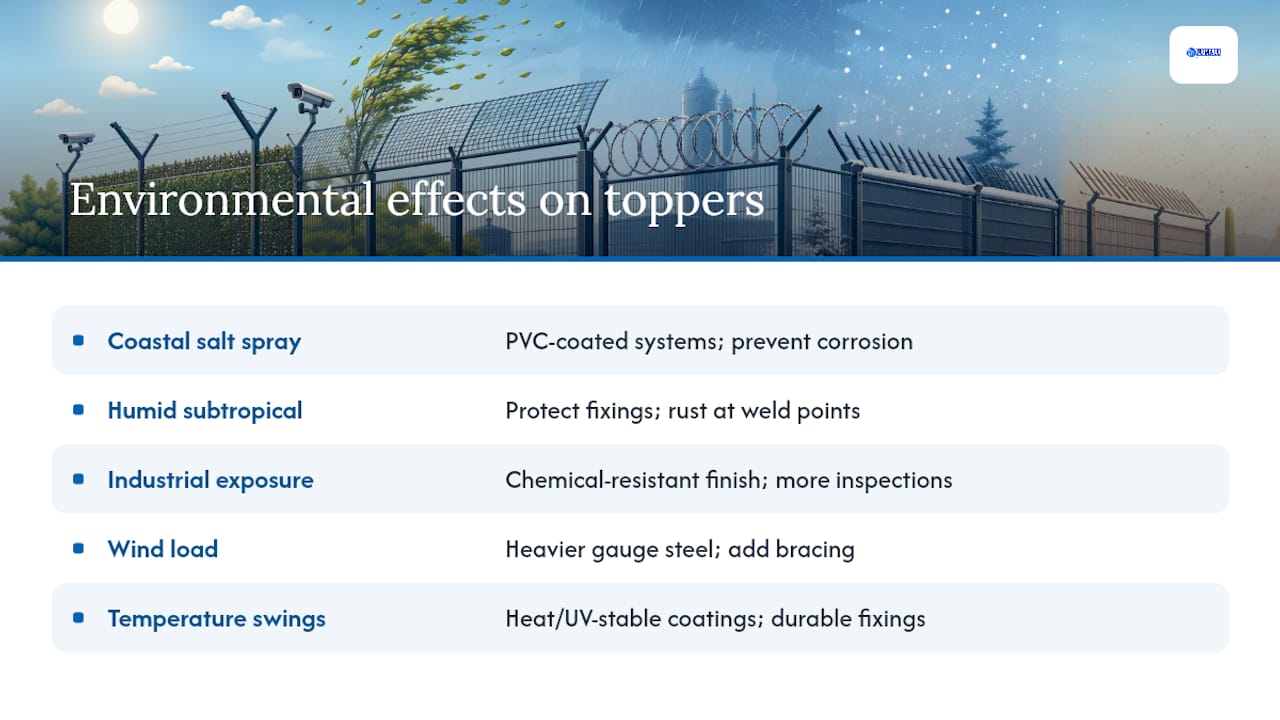
Temperature swings play a smaller but real role. Extreme heat can soften certain PVC coatings over decades of exposure, while properties in colder regions need fixings that won’t become brittle in low temperatures. None of this means one material wins everywhere. It means the honest answer to “what’s the best topper finish” is always “it depends on your specific site conditions,” which is exactly what a proper site assessment is designed to establish before installation begins.
What a realistic topper budget looks like
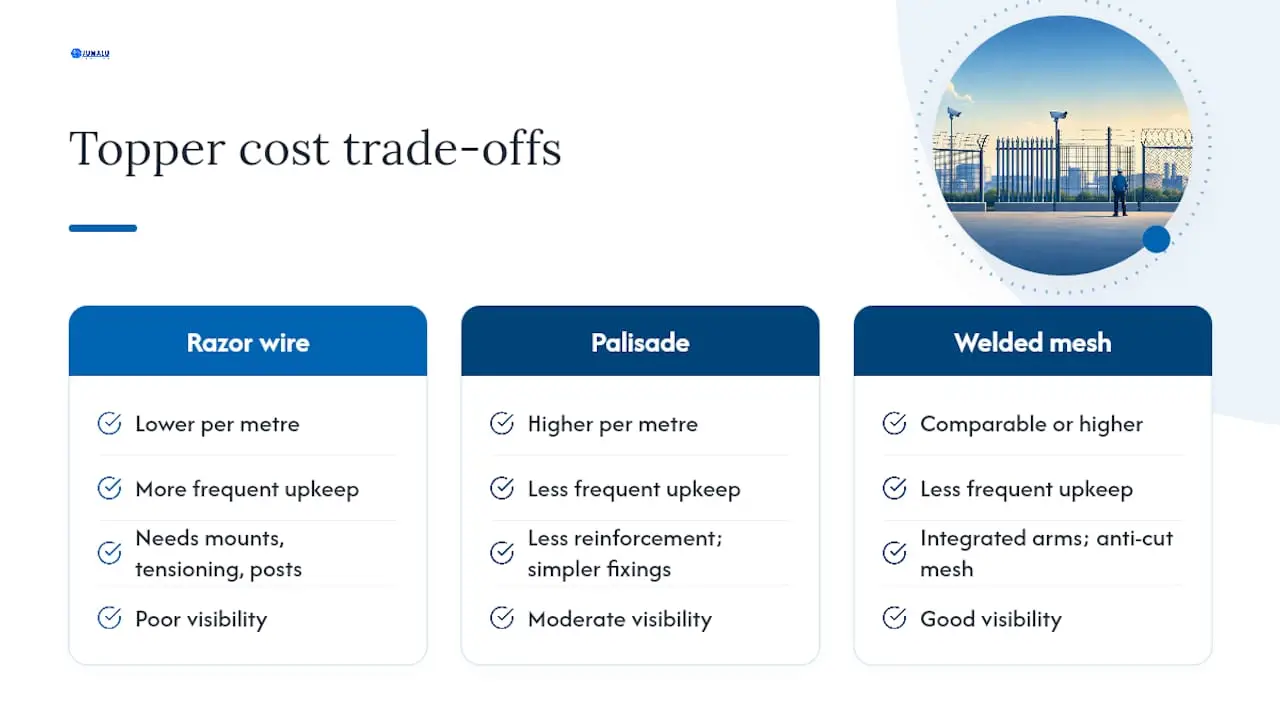
Costing security toppers accurately is difficult without a site visit, because perimeter length, mounting condition, and material choice all move the number independently. Concertina and flat-wrap razor wire tend to sit at the more affordable end per meter, but that figure climbs once you factor in mounting arms, tensioning labor, and any post reinforcement needed on an older fence.
D-section and palisade extensions cost more per meter than wire toppers but need less frequent maintenance, which shifts some of the expense from ongoing upkeep to upfront material cost. Welded mesh clear-view systems like ClamberPrufe typically land in a comparable or higher bracket than palisade extensions, reflecting the anti-cut mesh construction and integrated mounting arms, though the visibility benefit often justifies it for sites running CCTV.
Budgeting well means accounting for more than the topper itself. Post reinforcement, coating upgrades for coastal exposure, permit or by-law compliance costs, and a maintenance contract all belong in the total figure, not as afterthoughts once installation is underway. Property owners comparing quotes should ask each installer to itemize materials, labor, and any structural reinforcement separately, since a low headline price sometimes hides an incomplete scope that surfaces as a change order later. Jumalu Fencing’s product lines span from Econosecure through to MaxiSecure specifically so budget and threat level can be matched without over- or under-specifying a system, though final figures depend on the site itself and are available on request rather than published as flat rates.
When a topper is enough, and when you need a new fence
Adding a topper makes sense when the existing fence is structurally sound: posts set firmly, no significant rust at the base, and a single breach or opportunistic incident rather than a pattern of repeated attempts. In those cases, an anti-climb or anti-cut extension solves the actual problem at a fraction of full replacement cost.
Recurrent breaches, visibly leaning or rotted posts, or a fence line that creates CCTV blind spots regardless of what topper you add are different signals entirely. At that point you’re not solving a topping problem, you’re solving a foundation problem, and no amount of razor wire or mesh fixes a fence that’s already failing structurally. The practical next step is a proper site assessment with a qualified installer who can tell you honestly which category your fence falls into before you spend money in the wrong direction.
— Jaline
Get a ClamberPrufe site assessment from Jumalu Fencing
A professionally engineered clear-view security topper offers a more reliable alternative to piecing together generic razor wire and hoping it holds. The ClamberPrufe system combines anti-climb and anti-cut mesh with an unobstructed sightline, finished in galvanized or PVC-coated steel built for coastal and humid conditions, and every installation comes from a team that handles the fitting rather than leaving mounting to guesswork.
A site assessment covers your perimeter, existing fence condition, and any local by-law checkpoints before a quote is drawn up, so the number you receive reflects your actual site rather than a generic estimate. From there, Jumalu Fencing’s range, from ClamberPrufe Econosecure through to MaxiSecure, lets you match protection level to budget without over-specifying a residential boundary or under-specifying an industrial perimeter. If you manufacture-only need gates or mesh sections rather than a full topper system, the services overview covers those options too. Request a site assessment with a professional installer to get a firm quote and installation timeline for your property.
Sources
Before installing any security topper, review your municipality’s own fence by-law, using the Kouga Municipality by-law as a working example, alongside SANS 10400 for national building standards. Always confirm final requirements with your local planning or building office.
- KOUGA MUNICIPALITY FENCES AND FENCING BY-LAW
- Building Regulations South Africa – An Introduction
- Razor wire fencing in South Africa | Concertina & Flat-Wrap | Chemvet
FAQ
Is razor wire legal on a residential fence?
It depends entirely on your municipality’s zoning rules. Many authorities permit razor and barbed wire in industrial or agricultural zones but restrict or prohibit it on residential boundaries without prior approval, so check your local by-law before ordering material.
What is a clear-view fence topper?
A clear-view topper is a welded mesh anti-climb and anti-cut extension, like Jumalu Fencing’s ClamberPrufe system, that adds security height while keeping the sightline open for CCTV or manned observation. It’s a common choice for commercial and industrial sites that don’t want a solid topper blocking camera coverage.
How often should security toppers be inspected?
Exposed razor wire coils generally need quarterly checks because they’re prone to sagging, corrosion, and tampering. Welded mesh extensions can typically go on a six-month inspection cycle given their more rigid construction.
Do I need a permit to install a fence topper?
In most cases, yes, particularly for razor wire, barbed wire, or increased fence height. Municipal by-laws such as Kouga’s fencing by-law set specific rules on alterations, exemptions, and penalties, so confirming with your local authority before installation avoids costly rework.
How much does a ClamberPrufe installation cost?
Pricing depends on perimeter length, existing fence condition, and the specific ClamberPrufe product line chosen, from Econosecure to MaxiSecure. Current pricing isn’t published, so the accurate figure comes from a site assessment through Jumalu Fencing.