{
“@graph”: [
{
“@type”: “Article”,
“image”: {
“url”: “https://csuxjmfbwmkxiegfpljm.supabase.co/storage/v1/object/public/blog-images/organization-6538/1788649718879_Cropped-steel-palisade-profiles-in-dramatic-light.jpeg”,
“@type”: “ImageObject”,
“caption”: “Cropped steel palisade profiles in dramatic light.”
},
“author”: {
“url”: “https://jumalutech.co.za”,
“name”: “Jumalu Fencing”,
“@type”: “Organization”
},
“headline”: “3 Palisade Fencing Profiles and Heads Mapped to Site Risk”,
“publisher”: {
“url”: “https://jumalutech.co.za”,
“name”: “Jumalu Fencing”,
“@type”: “Organization”
},
“inLanguage”: “en-US”,
“description”: “Match palisade fencing profiles, head designs, and finishes to residential, commercial, or industrial threat levels. Includes a security-first installer.”,
“dateModified”: “2026-09-05T23:09:37.470Z”,
“datePublished”: “2026-09-05T23:09:37.470Z”
},
{
“@type”: “BreadcrumbList”,
“itemListElement”: [
{
“item”: “https://jumalutech.co.za”,
“name”: “Jumalu Fencing”,
“@type”: “ListItem”,
“position”: 1
},
{
“item”: “https://jumalutech.co.za/types-of-palisade-fencing”,
“name”: “3 Palisade Fencing Profiles and Heads Mapped to Site Risk”,
“@type”: “ListItem”,
“position”: 2
}
]
}
],
“@context”: “https://schema.org”
}
{
“@type”: “FAQPage”,
“@context”: “https://schema.org”,
“mainEntity”: [
{
“name”: “What are the three main types of palisade fencing?”,
“@type”: “Question”,
“acceptedAnswer”: {
“text”: “The three primary profile families are D-section pales, W-section (corrugated) pales, and angle or flat pales, with W-section offering the greatest stiffness for high-security sites.”,
“@type”: “Answer”
}
},
{
“name”: “What are the disadvantages of palisade fencing?”,
“@type”: “Question”,
“acceptedAnswer”: {
“text”: “Palisade fencing can leave visible climb points if pale spacing or head design doesn’t match the threat level, and installation quality issues like shallow footings materially reduce its effective security.”,
“@type”: “Answer”
}
},
{
“name”: “What is a devil’s fork fence?”,
“@type”: “Question”,
“acceptedAnswer”: {
“text”: “A devil’s fork is a multi-tine head design fitted to palisade pales that makes gripping the top rail painful and impractical, typically reserved for industrial, mining, and substation perimeters facing serious intrusion risk.”,
“@type”: “Answer”
}
},
{
“name”: “What is the alternative to palisade fencing?”,
“@type”: “Question”,
“acceptedAnswer”: {
“text”: “Clear view anti-climb systems like Jumalu Fencing’s ClamberPrufe offer an alternative that combines unobstructed visibility with anti-climb and anti-cut protection, addressing the visible climb points that standard palisade heads can leave.”,
“@type”: “Answer”
}
},
{
“name”: “How do I choose between D-section and W-section pales?”,
“@type”: “Question”,
“acceptedAnswer”: {
“text”: “Choose D-section for residential and light commercial boundaries where moderate deterrence is enough, and W-section where impact resistance and higher security, such as industrial or substation sites, are the priority.”,
“@type”: “Answer”
}
}
]
}
Steel palisade fencing falls into three structural families: D-section pales, W-section (corrugated) pales, and angle or flat pales, each paired with a head design ranging from rounded caps to devil’s fork spikes. The right choice comes down to one rule: match pale profile and head intensity to the site’s threat level, its climate, and the budget available for professional installation.
TL;DR:
- The choice of palisade profile and head design should be driven by the site’s threat level, security needs, and environmental conditions, not just cost.
- Higher security sites require W-section pales and multi-spike or devil’s fork heads, while lower risk boundaries can use D-section pales with simpler head designs.
- Proper installation, including deep footings and anti-tamper fixings, is crucial to maintain security, especially in coastal or humid environments requiring regular inspections.
- Coatings like hot-dip galvanising, powder coating, or PVC should match the site’s climate to ensure longevity and reduce maintenance, with galvanising preferred for corrosion resistance.
- Matching fence type, head design, and coatings to actual threat levels significantly improves security effectiveness rather than relying solely on appearance or catalog options.
Table of Contents
- Types of palisade fencing: pale profiles explained
- Head and spike designs: which deters and which just decorates
- Materials and finishes: hot-dip galvanising, powder coat, and PVC
- Matching fence type to site: residential, commercial, and industrial risk levels
- Installation and maintenance: what actually keeps a palisade fence secure
- What Jumalu Fencing sees in the field
- Get the right palisade or ClamberPrufe system installed correctly
- Sources
- FAQ
Types of palisade fencing: pale profiles explained
Every palisade system starts with the pale, the vertical steel picket that forms the barrier. The profile you choose determines stiffness, resistance to cutting tools, and how much the fence will cost per meter.
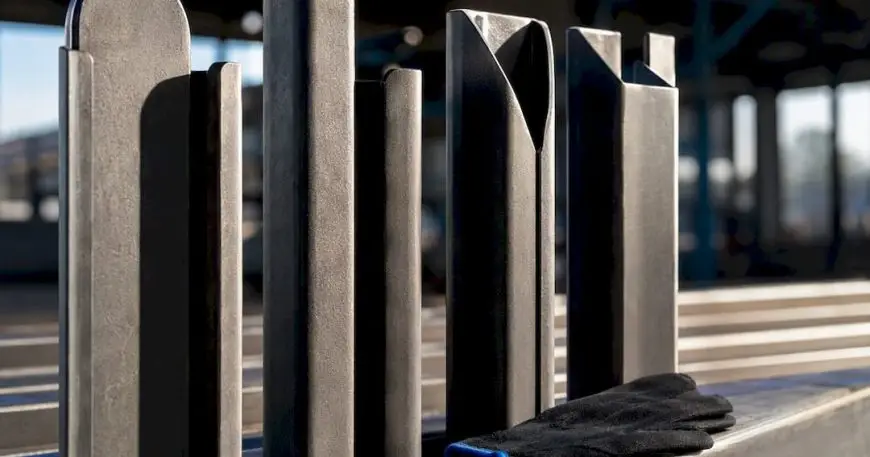
D-section pales are cold-rolled into a rounded D shape, typically 40mm to 76mm wide with wall thickness ranging from 1.6mm to 3mm depending on the manufacturer. They suit low-to-medium security applications: residential boundaries, schools, and commercial perimeters where deterrence matters more than resisting a sustained attack. The curved face gives some resistance to hand grips, which is one reason D-section remains the most widely fitted profile across South Africa.
W-section (corrugated) pales fold the steel into a W or zigzag profile. That extra fold increases the section modulus, meaning the pale resists bending and impact far better than a plain D-section of the same steel thickness. D-section pales are used for low-to-medium security while W-section pales provide greater stiffness and are specified for higher security applications, which is why you see W-section specified around substations, mining sites, and industrial yards where a vehicle or crowbar attack is a real scenario.
Angle and flat pales trade some rigidity for cost. An angle pale is bent into an L-shape; a flat pale is simply a straight steel bar. Both are cheaper to manufacture and install, making them common where budget rules or where the fence needs to match an existing boundary aesthetic rather than resist forced entry.
Profile choice never works in isolation. Pale spacing (commonly spaced a little over 10cm center to center), pale thickness, and overall panel width interact to determine how much force a section can absorb before it flexes or fails. Readers wanting a deeper technical breakdown of these components can review Jumalu Fencing’s complete guide to palisade construction, while those specifying D-section for a project can go straight to the D-section palisade fencing specifications.
- D-section: rounded profile, moderate thickness, best for residential and light commercial use
- W-section: corrugated fold, higher stiffness, specified for industrial and high-security sites
- Angle/flat: lowest cost, suited to budget projects or aesthetic matching
Head and spike designs: which deters and which just decorates
The top of the pale does more work than most buyers assume. A blunt, rounded head looks tidy but offers almost no climb resistance. A devil’s fork or multi-spike head does the opposite: it turns the top rail into a genuine physical deterrent.
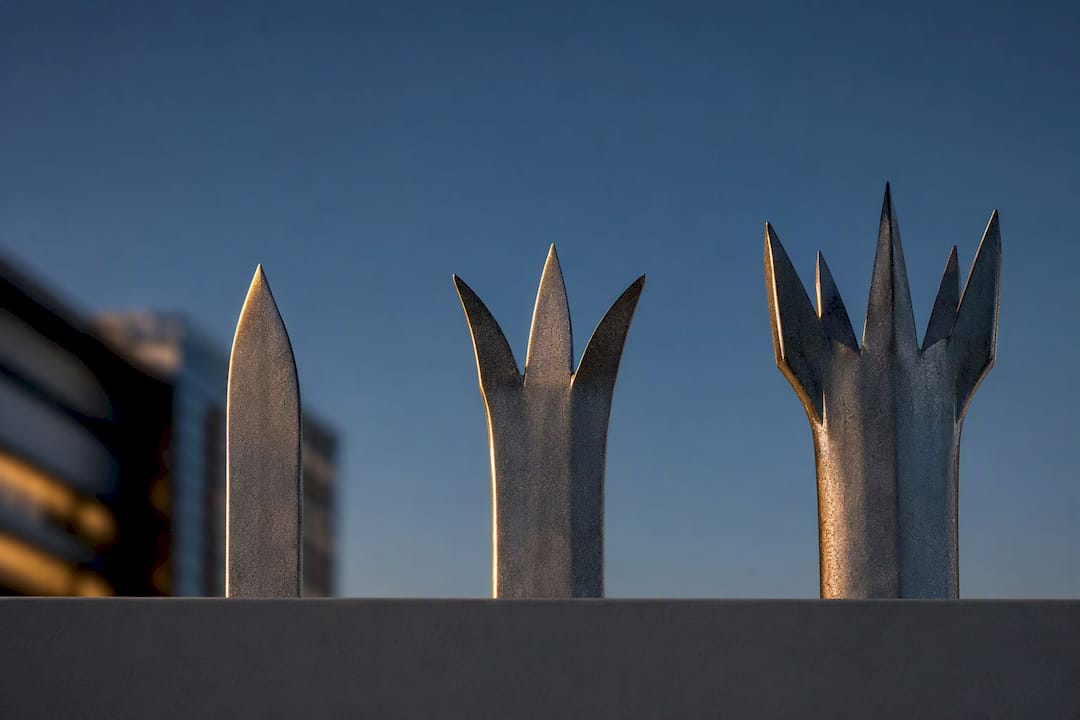
Common palisade head types include single-point, triple-point, rounded, square and notched designs, and South African suppliers extend that catalog further with 3-spike, 5-spike, 7-spike and devil’s fork variations to suit different threat levels.
- Single point: a simple sharpened tip, moderate deterrence, low snag risk
- Triple point (trident): three prongs spread the deterrent effect across a wider top edge
- 3/5/7 spike: increasing prong counts make both visual intimidation and physical resistance to hand grips
- Devil’s fork: an aggressive multi-tine design that makes gripping the top rail painful and impractical
- Rounded: smooth caps chosen for low-risk residential sites or where safety concerns outweigh deterrence
- Square and notched: flatter, less aggressive tops used where local regulation or foot traffic limits sharp features
Rounded and square heads suit properties near schools, walkways, or anywhere a sharp spike creates liability exposure. Triple-point and multi-spike heads suit commercial estates and industrial boundaries where climbing attempts are a genuine concern. Devil’s fork sits at the top end of the scale, typically reserved for high-value industrial sites, mining perimeters, and substations.
A supplier’s spike catalog exists because buyers select by mapping threat level to spike intensity rather than by appearance alone, and matching spike complexity to real risk is as much a psychological deterrent as a physical one. More tines mean more snag points for anyone attempting to scale the fence.
Pro Tip: Don’t default to the most aggressive spike option available. A devil’s fork on a suburban front boundary can trigger local by-law objections and creates unnecessary injury risk for children or delivery staff. Save the sharpest heads for sites where the threat genuinely warrants them.
Materials and finishes: hot-dip galvanising, powder coat, and PVC
The steel underneath the profile matters less than what protects it from rust. Coating options commonly offered include hot-dip galvanising, powder coating and PVC coating, and each carries different longevity and maintenance trade-offs.
Hot-dip galvanising dips fabricated steel into molten zinc, bonding a protective layer into the surface rather than just coating it. This process is widely recommended for longer corrosion resistance, particularly where the fence will face years of exposure without frequent upkeep.
Powder coating applies a dry, electrostatically charged finish that’s cured under heat. It offers a wide color range and a smoother finish than paint, though scratches expose bare metal faster than galvanising does.
PVC coating wraps the pale in a plastic layer, adding a second barrier against moisture on top of any underlying zinc treatment. It’s a common choice where aesthetics and weather resistance both matter.
Painted steel without galvanising is the cheapest route but the least durable, and it typically needs recoating within a few years in humid conditions.
- Coastal and humid environments favor galvanising plus a topcoat, since the extra initial cost reduces life-cycle maintenance
- Inland, low-humidity sites can tolerate powder coating alone with less risk
- PVC suits properties wanting a specific color without sacrificing corrosion protection
Matching fence type to site: residential, commercial, and industrial risk levels
Not every property needs the same combination of pale, head, and coating. The security level you’re actually protecting against should drive every decision below, not the other way around.
For low-risk residential boundaries, D-section pales paired with rounded, square, or single-point heads strike the right balance between curb appeal and deterrence. For medium-risk commercial or estate perimeters, stronger D-section or entry-level W-section pales combined with triple-point or 3/5/7 spike heads raise the deterrent without looking overtly aggressive. For high-risk industrial and substation sites, W-section or reinforced D-section pales fitted with devil’s fork or dense multi-spike heads deliver the strongest resistance available in this category.
Palisade fencing is widely used across residential, commercial and industrial contexts because of its visibility and deterrent profile, though it does leave visible climb points if pale spacing or head selection is wrong for the site.
- Residential: D-section, rounded or single-point heads, panel heights commonly around typical residential fence heights
- Commercial/estate: reinforced D-section, triple-point or 5-spike heads, heights suitable for commercial or estate boundaries
- Industrial/substation: W-section, devil’s fork or 7-spike heads, heights up to 3m with anti-climb toppings
Gates and access points need matching specification. A high-security perimeter undermined by a light-duty gate is a common and avoidable weak point. For guidance on how security ratings apply to South African sites specifically, see Jumalu Fencing’s overview of security rating systems.
Installation and maintenance: what actually keeps a palisade fence secure
Profile and head choice only matter if the fence is installed correctly. Deeper footings and anti-tamper fixings prevent easy toppling or removal, and installation quality has as much bearing on real-world security as the steel specification itself. Shallow footings and loose fixings remain the most common weakness installers find on existing fences, often invisible until someone tests the boundary.
Coastal properties need more frequent attention. Suppliers generally recommend regular inspections and touch-up treatments even on galvanised finishes, since salt air accelerates corrosion at joints and cut edges faster than open-air exposure inland.
Before signing off on any installer, ask:
- What footing depth and concrete mix will you use for this soil type?
- Are the fixings anti-tamper, and can they be removed from the outside?
- How does pale spacing here compare to the security level I need?
- What’s the inspection schedule for the first two years?
Pro Tip: Walk the completed fence line yourself and try to shake a pale near ground level. If it moves more than a few millimeters, the footing depth is likely insufficient for the site’s risk profile. For a step-by-step breakdown of what a proper installation involves, review Jumalu Fencing’s fencing installation process guide.
What Jumalu Fencing sees in the field
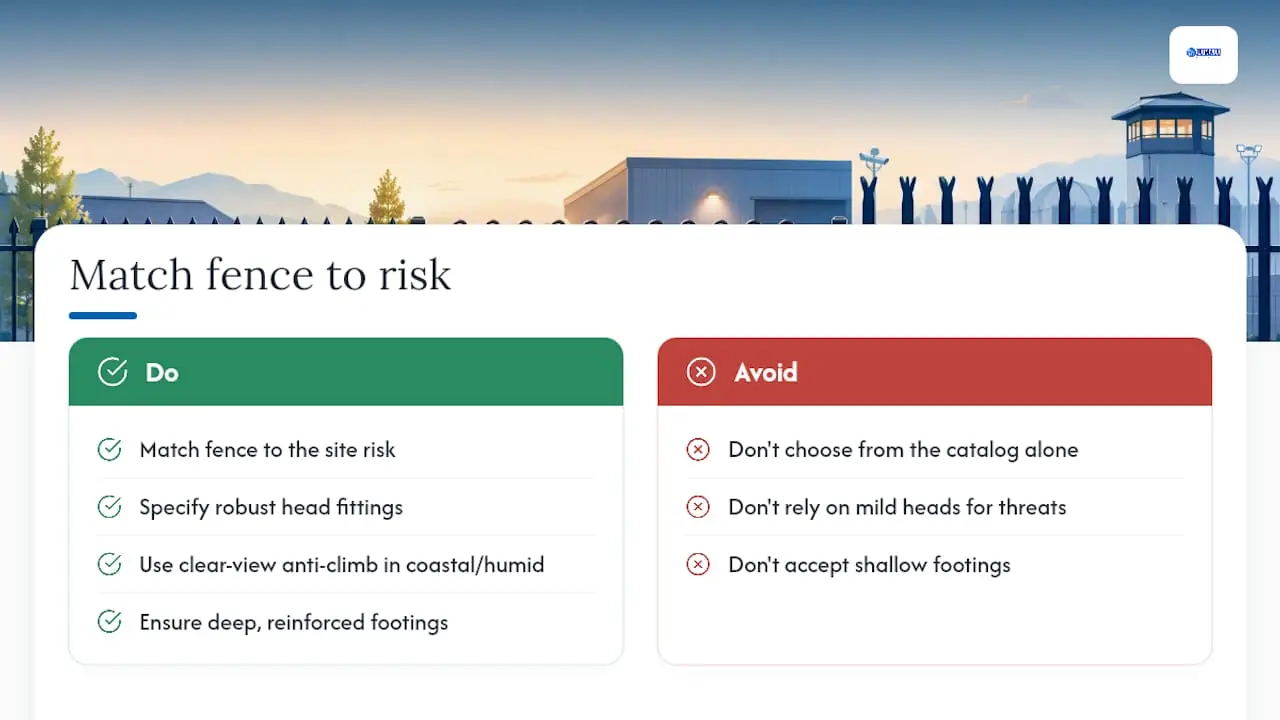
Profile and head specifications only tell part of the story until they’re installed against real weather and real intrusion attempts. Clear view anti-climb systems combine anti-climb and anti-cut properties with an unobstructed sightline, offering improved durability in coastal and humid installations compared to some standard palisade coatings…
Installers repeatedly find the same failure pattern on older palisade fences: the profile was adequate, but the head was too mild for the site’s actual threat level, or the footing was too shallow to hold under sustained pressure. Matching the fence to the risk, not to the catalog page, is where most security gains actually come from.
— Jaline
Get the right palisade or ClamberPrufe system installed correctly
Choosing between D-section, W-section, and clear view alternatives is only half the job. Manufacturers and suppliers offer D-section palisade fencing alongside clear view systems, allowing specifications matched to actual threat levels rather than available stock.
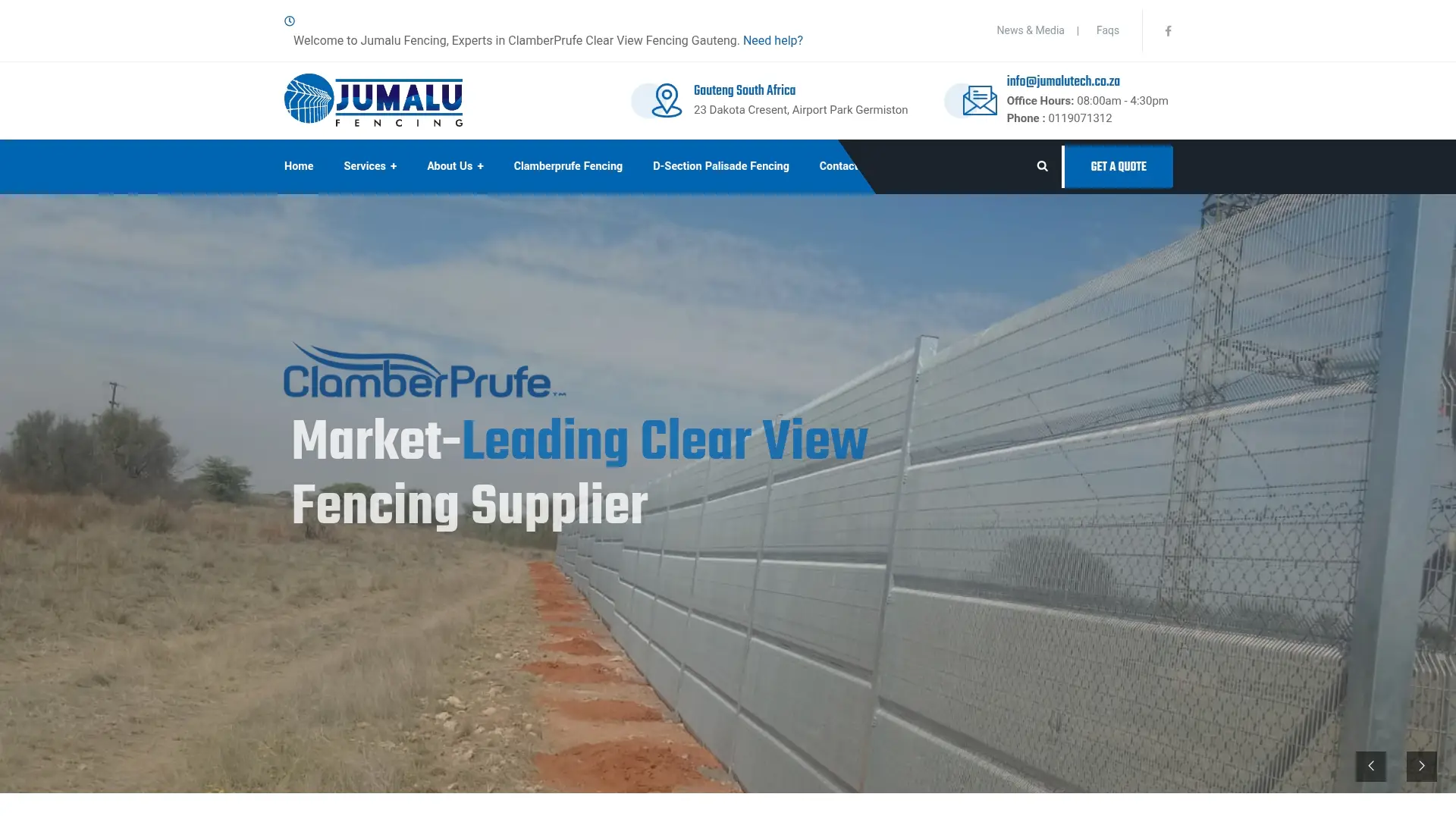
Some clear view systems use anti-climb and anti-cut designs to eliminate visible climb points without sacrificing sightlines, benefiting properties needing both visibility and security. Galvanised or PVC-coated finishes can enhance durability in coastal and humid conditions. Start by reading the complete guide to fencing materials to confirm which coating suits your site, then request a tailored quote for your property’s threat level and boundary length.
Sources
- PALISADE TOPS — fencing heads shapes
- Corrugated and Angle Pales of Palisade Fence
- Palisade Fence | Strong and Beautiful Metal Fence
FAQ
What are the three main types of palisade fencing?
The three primary profile families are D-section pales, W-section (corrugated) pales, and angle or flat pales, with W-section offering the greatest stiffness for high-security sites.
What are the disadvantages of palisade fencing?
Palisade fencing can leave visible climb points if pale spacing or head design doesn’t match the threat level, and installation quality issues like shallow footings materially reduce its effective security.
What is a devil’s fork fence?
A devil’s fork is a multi-tine head design fitted to palisade pales that makes gripping the top rail painful and impractical, typically reserved for industrial, mining, and substation perimeters facing serious intrusion risk.
What is the alternative to palisade fencing?
Clear view anti-climb systems like Jumalu Fencing’s ClamberPrufe offer an alternative that combines unobstructed visibility with anti-climb and anti-cut protection, addressing the visible climb points that standard palisade heads can leave.
How do I choose between D-section and W-section pales?
Choose D-section for residential and light commercial boundaries where moderate deterrence is enough, and W-section where impact resistance and higher security, such as industrial or substation sites, are the priority.