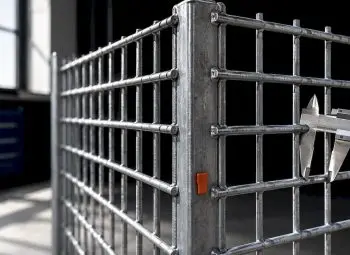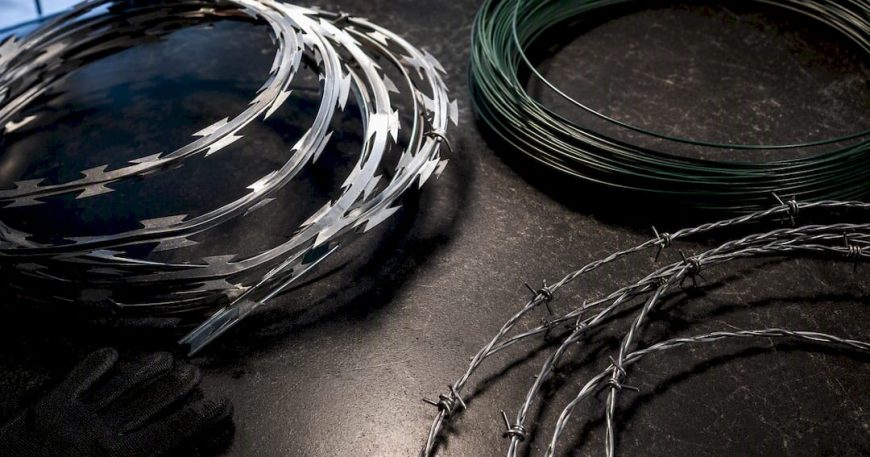
Razor wire suits high-security perimeters where climbing must be physically prevented; barbed wire works as a low-cost deterrent for agricultural and boundary marking; electric conductors add active deterrence to an existing barrier; and stainless or PVC-coated variants of any type extend service life in coastal or humid climates. The right choice depends on threat level, site exposure, and local regulation, not price alone.
TL;DR:
- Razor wire in concertina form provides the highest physical deterrence but requires regular maintenance, especially in coastal environments.
- Electric conductors add a psychological layer of deterrence but must meet strict standards, be properly earthed, and maintained to function effectively.
- Galvanised wire lasts 10 to 15 years inland, while stainless steel offers superior corrosion resistance suitable for coastal or humid sites.
- Local regulations often restrict barbed or razor wire on residential boundaries, making compliance checks essential before installation.
- System performance depends more on correct installation, earthing, and maintenance than on the wire material or coating alone.
Table of Contents
- Types of security fence wire at a glance
- Razor wire: material choices, structural types and blade models
- Barbed wire varieties: construction, materials and when to use them
- Electric fence wire and conductors: specs and safety standards
- Coatings, corrosion resistance and expected longevity by environment
- How to choose the right security fence wire: a decision checklist
- Jumalu’s perspective: pairing wire with ClamberPrufe clear-view fencing
- What the standard advice gets wrong
- Get a professional wire and fencing specification from Jumalu Fencing
- Sources
- FAQ
Types of security fence wire at a glance
Every security perimeter draws from a short list of proven wire families, and matching the right one to the job saves money and disappointment down the line. Razor wire delivers the strongest physical deterrent per meter and typically tops a wall or clear-view panel rather than standing alone. Barbed wire costs less and works well for agricultural boundaries or low-risk sites, though it will not stop a determined intruder equipped with gloves or cutters. Electric conductors add a psychological and physical deterrent layer to an existing fence, provided the system carries a valid Certificate of Compliance. Concertina and coil wire form a dense, three-dimensional barrier favoured by correctional and military sites. High-tensile line wire underpins mesh and palisade systems, giving the whole structure its strength. Stainless and PVC-coated finishes exist across all these categories specifically to fight corrosion in harsh climates.
- Razor wire: highest deterrence, usually a topping, moderate to high maintenance in coastal air
- Barbed wire: low cost, standalone or topping, moderate maintenance, limited stopping power
- Electric conductors: active deterrent layer, requires certified installation and ongoing system checks
- Concertina/coil wire: dense multi-layer barrier for industrial and correctional sites
- High-tensile line wire: structural backbone for mesh and palisade fencing, low stretch, long service life
- Stainless/PVC-coated variants: available across all types, chosen for corrosion resistance in humid or coastal zones
Each type gets a full technical breakdown in the sections that follow, including mesh fencing options that often pair with these toppings.
Razor wire: material choices, structural types and blade models
Razor wire earns its reputation as the sharpest tool in perimeter security, and the material behind the blade matters as much as the blade itself. Hot-dip galvanised razor wire remains the standard choice for general security work, offering solid corrosion resistance at a reasonable price. Electro-galvanised versions cost less but wear faster, making them a poor fit for anything beyond short-term or indoor applications. PVC-coated razor wire adds a polymer sleeve over the galvanised core, which slows corrosion further and reduces the risk of superficial rust bleeding onto walls or pavements. Stainless steel razor wire sits at the top of the price range, and it earns that premium on coastal sites where salt air destroys galvanised coatings within a few years.
Structure changes how the wire performs as much as material does. Concertina coils create a dense, springy barrier that expands into a three-dimensional obstacle, standard on military and correctional perimeters. Flat wrap razor wire lies close to the fence line, giving commercial entrances and boundary walls a neater profile without sacrificing much deterrence. Single loop and straight-line configurations sit between these two extremes, often chosen where budget or aesthetic rules limit how bulky the barrier can look. Welded mesh razor panels fuse blades into a rigid grid, which resists cutting attacks better than loose strand wire but costs more to manufacture and install.
Blade spacing and tensile strength deserve direct questions to any supplier:
- What is the blade spacing, and does it meet the deterrence standard for this site’s risk level?
- What is the tensile strength of the core wire, in kilograms or newtons?
- Is the coating hot-dip galvanised, electro-galvanised, PVC-coated, or stainless?
- What warranty applies against corrosion and blade fatigue?
Pro Tip: Ask for the coil diameter and wrap count when comparing concertina products. A wider coil with more wraps per meter gives a taller, denser barrier than a narrow coil sold at a similar price.
Barbed wire varieties: construction, materials and when to use them
Barbed wire remains the most widely used fencing wire on the planet, largely because it costs a fraction of razor wire while still discouraging casual trespass. Twisted barbed wire, the classic double-strand design, wraps two line wires together with barbs spaced at intervals. Reverse-twisted variants alternate the twist direction to resist unwinding under tension, a detail that matters on long agricultural runs where wind and livestock pressure test the wire daily. Single-strand barbed wire exists but sees limited security use since it lacks the redundancy of a twisted pair. High-tensile barbed wire uses a harder-drawn steel core, which holds tension over longer spans and needs fewer support posts.
Material and coating choices follow the same logic as razor wire. Standard hot-dip galvanised barbed wire meets SANS 675 fencing wire specifications and handles most inland climates well for a decade or more. PVC-coated barbed wire adds a colour option, usually black or green, along with an extra layer of corrosion protection that suits residential and light commercial settings. Stainless barbed wire exists for coastal or industrial sites with corrosive air, though the price premium pushes many buyers toward galvanised wire with more frequent inspection instead.
Barbed wire suits low-to-moderate risk sites: farm boundaries, warehouse perimeters, and rural property lines where the goal is deterrence rather than absolute physical prevention.
- Works well as a topping over palisade or mesh fencing to add height and deterrence cheaply.
- Falls short against a prepared intruder with gloves, a blanket, or cutting tools.
- Faces municipal by-law restrictions in many residential zones, so check local rules before installing it on a boundary that fronts a public road.
Electric fence wire and conductors: specs and safety standards
Electric conductors do not replace a physical barrier. They add a live deterrent layer on top of one, and the wire you choose matters far less than the system it belongs to. Bare high-tensile steel conductor remains the most common choice for security applications, valued for its low resistance and long service life. Stainless steel conductor resists corrosion better in humid or coastal zones, making it worth the extra cost anywhere salt air shortens the life of galvanised wire. Multi-strand or braided conductors flex more easily around corners and gate points, though they carry slightly higher resistance than solid stainless. Polytape, polywire, and polyrope trade some conductivity for visibility and easy handling, and installers generally reserve them for animal control rather than perimeter security. Insulated conductor covers lead-out runs where a live wire must pass near a walkway or gate without risking accidental contact.
The technical baseline is not optional. The PL675 specification for electric fences recommends a minimum 1.6mm solid stainless steel conductor for adequate current-carrying capacity, sets a resistance target below 10 ohms per meter, and caps wire tension at roughly 20 kilograms per strand to balance performance against post stress. Double-insulated lead-out cable is required for longer runs between the energizer and the fence line. SANS 10222-3 governs installation categories, covering insulators, earthing, corrosion protection, and the safety features every registered installer must apply, whether the fence protects a home, a farm, or an industrial site.
A tensioning check that installers actually use: a properly tensioned live wire should allow moderate hand pressure to bring two adjacent strands together without excessive resistance or slack. Too tight, and posts fail under load; too loose, and the system sags into contact with vegetation or the ground.
Three practical points determine whether an electric conductor system actually works:
- Energizer output must match the fence length and wire type. Undersized units leave long runs with a weak pulse that animals and intruders alike learn to ignore.
- Earthing has to meet SANS 10222-3 requirements. A poorly earthed system delivers an inconsistent shock and can fail electromagnetic compatibility checks entirely.
- Vegetation control is ongoing, not a one-time task. Grass and branches touching a live wire drain current and can trip the energizer’s fault detection.
You may not electrify barbed or razor wire directly. National guidance treats these as separate physical deterrents, with rules limiting energizer output and setting minimum clearances in urban zones. Combining the two into one live circuit violates both the intent of the standard and, in most jurisdictions, the letter of it.
Regular maintenance prevents the most common failure mode in electric security fencing: arcing caused by loose connections or vegetation contact. Check joints and clamps quarterly, inspect insulators for cracking after storms, and test resistance annually against the original commissioning readings.
Coatings, corrosion resistance and expected longevity by environment
The coating on any fence wire decides how long it actually lasts, and matching it to climate is where most buyers either save money or waste it. Hot-dip galvanised wire, with its thick zinc layer, handles inland and moderate climates for long service life with minimal upkeep. Electro-galvanised wire applies a thinner zinc layer through electroplating, which costs less upfront but corrodes noticeably faster, particularly in humid regions. Stainless steel resists corrosion better than either galvanising method and justifies its premium on coastal properties where salt-laden air eats through zinc coatings within a handful of years. PVC coating adds a polymer barrier over galvanised steel, slowing rust bleed and giving buyers a colour option, though it will not outperform stainless in genuinely aggressive marine environments.
- Hot-dip galvanised: strong general-purpose choice, 10 to 15 years typical service in inland climates
- Electro-galvanised: budget option, shorter service life, best for temporary or low-risk applications
- Stainless steel: premium corrosion resistance, worth the cost on coastal or industrial sites
- PVC-coated: adds a protective layer and colour choice over galvanised or stainless cores
Coastal and humid sites benefit disproportionately from higher-grade finishes, since the upfront premium for stainless or thicker galvanising often costs less over the fence’s lifetime than repeated replacement of a cheaper coating. Budgeting for a periodic inspection, rather than assuming any coating is maintenance-free, is what actually protects that investment.
How to choose the right security fence wire: a decision checklist
Choosing wire without a structured process is how properties end up with the wrong barrier for their actual risk. Work through these steps in order, and you will land on a specification you can defend to a contractor or an insurer.
- Define the threat and use case. A rural boundary marking cattle differs entirely from a warehouse storing high-value stock.
- Survey site exposure. Note coastal proximity, humidity, vegetation load, and whether the fence line runs near a public path.
- Check local by-laws before specifying anything. Many municipalities restrict barbed or razor wire on residential boundaries, and electric fencing always requires compliance with national standards.
- Choose material and structure together. A high-risk industrial site might combine stainless razor wire concertina with a mesh base; a farm boundary might need only galvanised barbed wire.
- Plan maintenance from day one. Budget for annual inspections rather than assuming any wire type is install-and-forget.
- Request installer credentials. For electric systems, insist on a registered EFSI installer and a documented Certificate of Compliance before signing off.
Ask any contractor these questions directly: what is the exact material specification and coating, what tensile strength does the wire carry, what warranty applies, and can they produce a Certificate of Compliance for electric work. A contractor who hesitates on any of these is a signal to look elsewhere.
Pro Tip: If a site has irregular topography, dense vegetation near the boundary, or a history of attempted break-ins, skip the DIY kit entirely and request a professional site survey. The cost of getting conductor spacing or earthing wrong on a live system far exceeds the price of a proper assessment.
Jumalu’s perspective: pairing wire with ClamberPrufe clear-view fencing
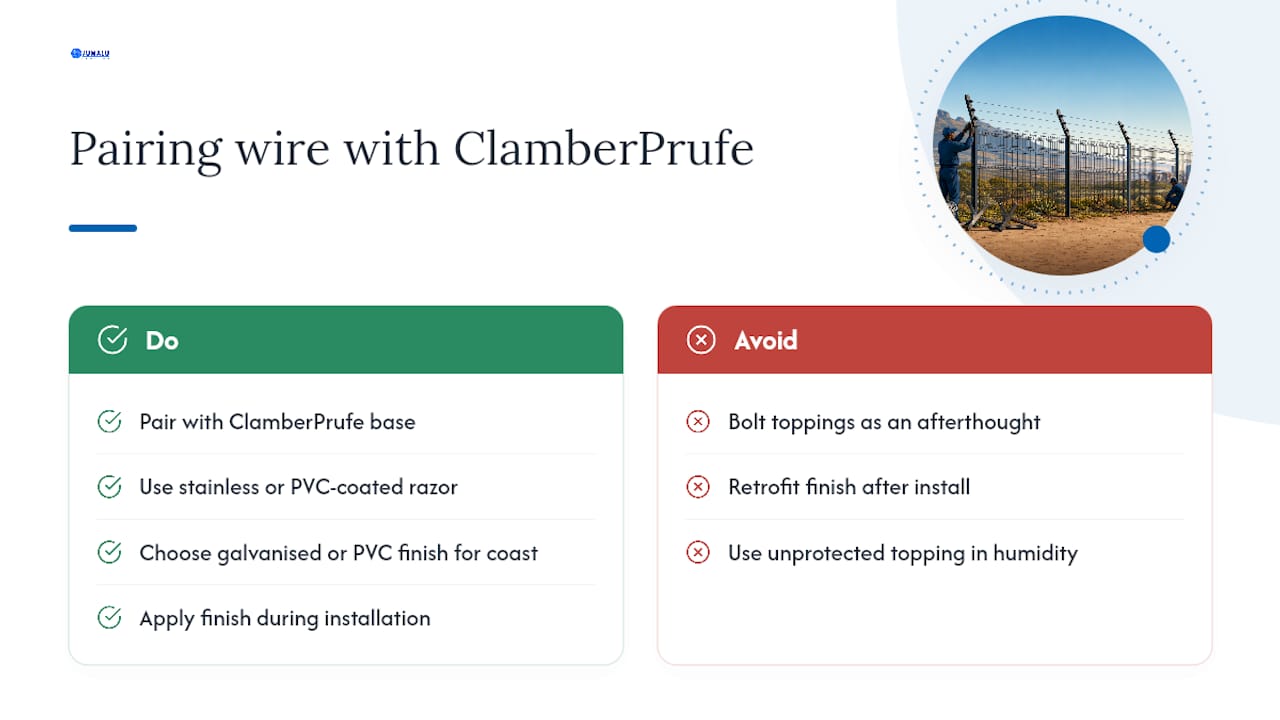
Wire toppings only work as well as the barrier underneath them, which is why Jumalu Fencing designs ClamberPrufe clear-view fencing with anti-climb and anti-cut properties built into the panel itself, not bolted on as an afterthought. Pairing a stainless or PVC-coated razor topping with a ClamberPrufe base gives coastal and humid sites the corrosion resistance they need without sacrificing the unobstructed visibility that clear-view panels are known for. On humid or coastal installations, Jumalu Fencing typically recommends galvanised or PVC-coated finishes matched to the client’s exposure level, applied during the installation process rather than retrofitted later.
What the standard advice gets wrong
Most guidance on security wire treats material choice as the whole decision, when the real failure point is almost always the system around it. A stainless conductor on a poorly earthed circuit performs worse than a cheaper wire installed to specification. The conventional wisdom also underweights local by-laws. Property owners specify razor or barbed wire based on price and deterrence value, then discover a municipal restriction after installation. My honest read: certification and site survey matter more than the wire grade itself, and readers should verify installer credentials and SANS 10222-3 compliance before comparing coating options. Get the system right first. The wire choice becomes straightforward once threat, climate, and regulation are actually mapped out, rather than guessed at from a supplier catalogue.
— Jaline
Get a professional wire and fencing specification from Jumalu Fencing
Jumalu Fencing solves the exact problem this article walks through: matching the right wire family, coating, and structure to your site without the guesswork of comparing suppliers on price alone. Where a generic wire retailer sells you a coil and leaves installation and compliance to figure out, Jumalu Fencing manufactures, supplies, and installs the full system, from high-tensile line wire and razor wire toppings through to the ClamberPrufe clear-view fencing that pairs anti-climb panels with the corrosion-resistant finishes this guide covers.
Residential, commercial, industrial, and mining clients across South Africa work with Jumalu Fencing for tailored specifications, finance options on larger installations, and expert aluminum & iron fence installation Utah backed by documented compliance where electric systems are involved. If your site needs a coastal-grade finish, a specific tensile rating, or a topping matched to an existing wall, request a site assessment and a formal quote through the security fencing terminology guide or reach out directly for a tailored specification on your property.
Sources
FAQ
What is the best fence wire to stop intruders?
Razor wire, particularly in concertina form, offers the strongest physical deterrent of any single wire type, though it performs best as a topping over a solid base like ClamberPrufe clear-view fencing rather than as a standalone barrier.
Can I electrify barbed or razor wire for extra security?
No. National guidance explicitly prohibits electrifying barbed or razor wire, and electric conductors must run as a separate system with its own certified installation.
How long does galvanised fence wire last compared to stainless steel?
Hot-dip galvanised wire typically lasts 10 to 15 years in inland climates, while stainless steel outperforms it in coastal or humid zones where salt air corrodes zinc coatings within a few years.
Do I need a certificate for an electric security fence?
Yes. Installations should comply with SANS 10222-3, and a registered EFSI installer should issue a documented Certificate of Compliance before the system goes live.
Is barbed wire allowed on residential boundaries?
It depends on the municipality. Many local by-laws restrict barbed or razor wire on residential boundary lines facing public roads, while allowing broader use on agricultural or industrial properties.