TL;DR:
- Effective property perimeter security combines physical barriers, electronic detection, and verified response workflows to prevent unauthorized access. Proper system design emphasizes active intervention, maintenance, and integration with central monitoring to ensure rapid and reliable incident response. Regular testing, sensor health monitoring, and adherence to best practices mitigate system failures and enhance site protection.
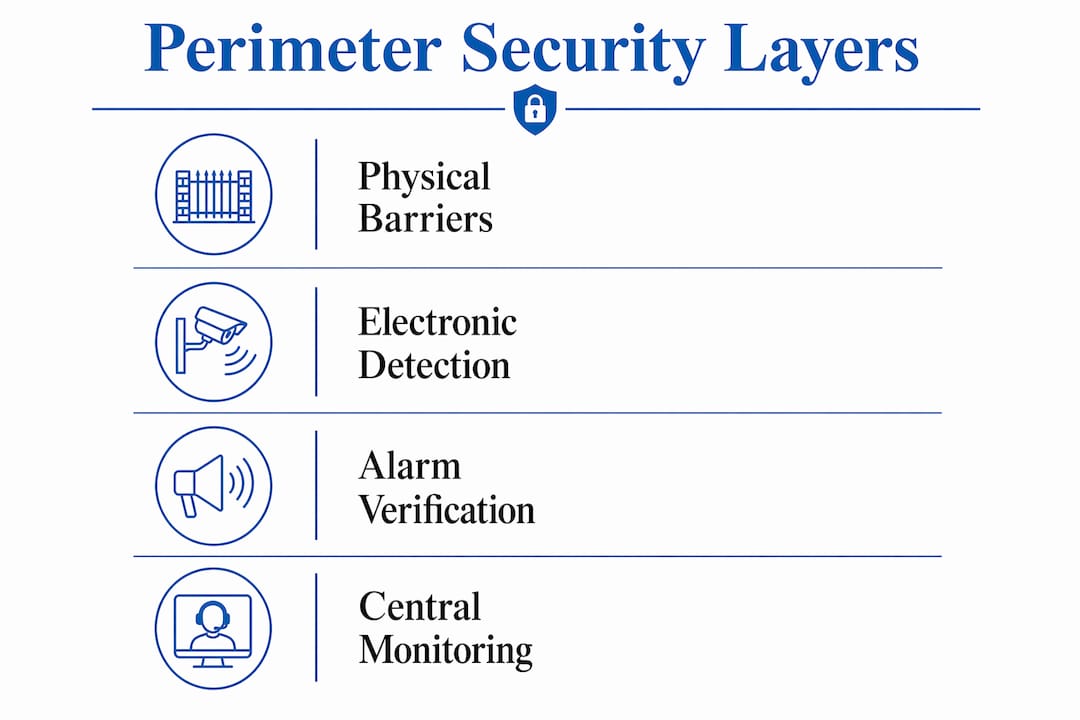
Property perimeter security is defined as a multi-layer system combining physical barriers, electronic detection, and verified intervention protocols to deter unauthorized entry and protect assets. This property perimeter security guide covers every layer you need: from fence selection and gate design to alarm workflows and central monitoring integration. Most commercial intrusions last only 8–10 minutes, which means your detection and response system must operate faster than any human can react manually. Interface Systems and FortSense both confirm that passive recording alone fails to stop incidents. The only approach that works is a structured Detect, Verify, Intervene model built into every layer of your perimeter.
What are the key physical security components for a property perimeter?
Physical barriers are the first and most visible layer of any perimeter security plan. They do not just block entry. They delay it long enough for detection and response systems to activate.
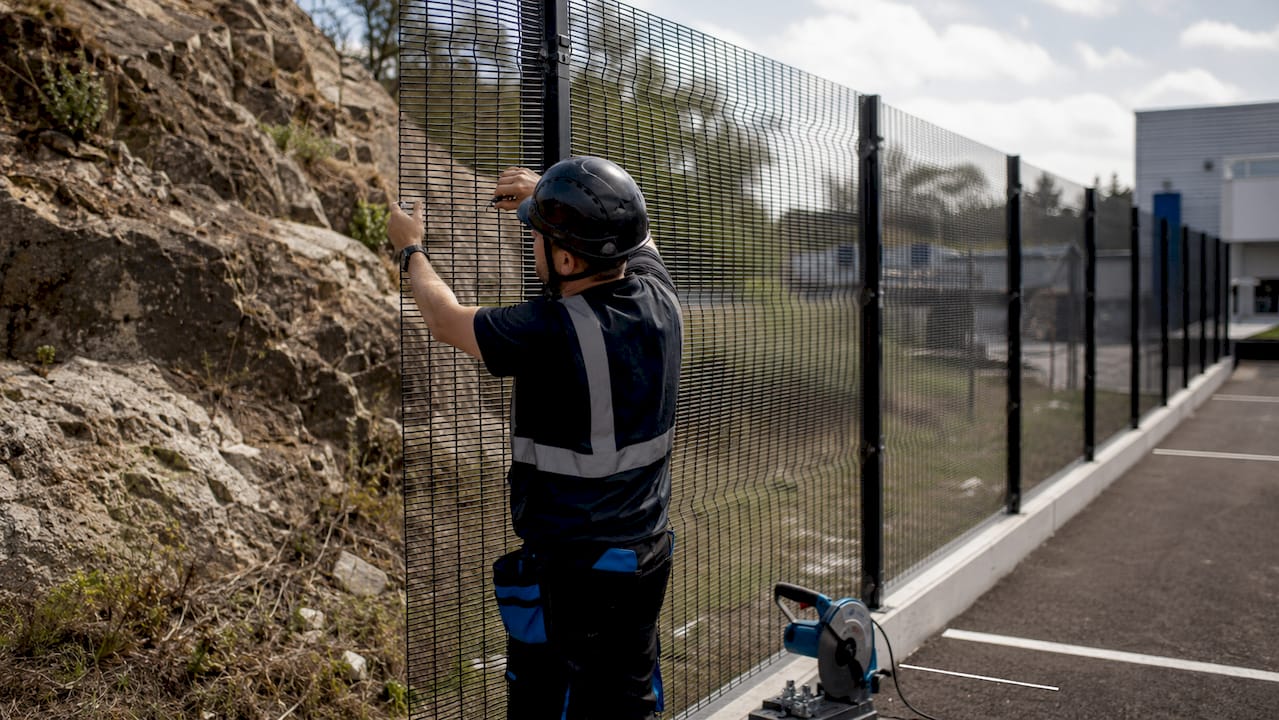
Anti-climb fencing at heights between 1.8 meters and 3 meters is the standard for low-to-medium risk sites. Fence heights from 1.8m to 4.5m correspond to risk levels ranging from general residential to critical infrastructure. The higher the fence, the longer a forced entry attempt takes, and that delay is what gives your alarm system time to trigger a response.
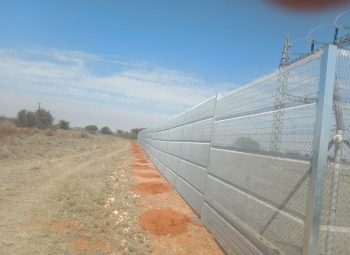
Clear-view fencing, such as ClamberPrufe Clear View Fencing, adds a further advantage. The open mesh design provides unobstructed sightlines for guards and cameras, removing the concealment that solid walls or dense palisade fencing can create. Visibility is a deterrent in itself.
| Fencing Type | Security Benefit | Key Consideration | Relative Cost |
|---|---|---|---|
| Anti-climb mesh | Delays forced entry; no footholds | Height and gauge selection | Medium |
| Clear-view panel | Full visibility; anti-cut wire | Requires professional installation | Medium to high |
| Palisade fencing | Visual deterrent; spike tops | Concealment risk at base | Low to medium |
| Welded mesh panels | Rigid; tamper-resistant | Less effective without topping | Low |
Gates are controlled entry points and must match the security rating of the surrounding fence. A high-tensile clear-view fence paired with a lightweight or poorly locked gate creates an obvious weak point. Secure locking mechanisms, including electromechanical locks and access control readers, are non-negotiable at every vehicle and pedestrian gate.
Pro Tip: Layer your physical defenses. Place a secondary inner fence or anti-vehicle barrier at high-value zones so that breaching the outer perimeter does not immediately expose critical assets.
Explore the full range of mesh fencing options to match fence type to your specific risk profile and site conditions.
How do electronic detection and verification systems enhance perimeter security?
Electronic detection converts a physical barrier into an active warning system. Without it, a fence is only as effective as the person watching it.
Perimeter intrusion detection systems (PIDS) include vibration sensors, infrared beam detectors, and fence-mounted fiber optic sensors. Each technology suits different environments. Vibration sensors work well on rigid mesh panels. Infrared beams cover open ground between fence lines. Fiber optic sensors detect cut or climb attempts directly on the fence wire. Sensor fusion linking fiber optic sensors to PTZ camera presets enables near-instant visual verification before an intruder crosses the perimeter. This sub-second camera recall is what separates a verified alarm from a missed incident.
AI-powered camera analytics are now a standard recommendation for any site with more than 10 cameras. Edge AI analytics reduce false positive alarms by 85–95%, according to IHS Markit research. That reduction directly cuts operator fatigue and lowers the risk of a real alarm being dismissed as noise.
| Detection Technology | Primary Function | Pros | Typical Use Case |
|---|---|---|---|
| Vibration sensors | Detects fence disturbance | Low cost; easy to install | Mesh and palisade fences |
| IR beam detectors | Detects crossing of beam | Wide coverage | Open ground, driveways |
| Fiber optic sensors | Detects cut or climb on fence | High sensitivity | High-security perimeters |
| PTZ cameras with AI | Visual verification | Reduces false alarms significantly | All commercial sites |
Camera placement follows sensor zones. Each sensor zone maps to one or more camera presets, so an alarm trigger automatically slews the nearest PTZ camera to the exact location. This removes the need for an operator to manually search through multiple feeds during a time-critical event.
Pro Tip: Assign static IP addresses to every perimeter camera and maintain a master MAC-to-IP spreadsheet. DHCP address changes are one of the most common causes of camera dropouts during live alarm events.
For sites requiring professional CCTV and access control integration, working with a specialist installer ensures sensor-to-camera mapping is configured correctly from the outset.
What are the best practices for a perimeter security workflow?
The property perimeter protection workflow that consistently delivers results follows three steps: Detect, Verify, and Intervene. Security expert Steve Womer, cited by Interface Systems, confirms that shifting from passive recording to active intervention is the single most important operational change a facility manager can make.
Here is how an effective workflow operates in practice:
- Detection. A sensor triggers an alarm event. The system logs the zone, time, and sensor type.
- Verification. The linked camera preset recalls automatically. An operator or AI system reviews the feed within seconds to confirm whether the event is a genuine threat or a false alarm.
- Intervention. A confirmed threat triggers a predefined response: audio challenge via speaker, dispatch of on-site security, or escalation to an armed response service.
The tiered alarm workflow developed by FortSense adds further structure. Level 1 events are auto-dismissed by the system based on preset filters. Level 2 events trigger camera slewing for operator review. Level 3 events escalate to live operator action and external response. Alarm fatigue causes guards to ignore valid alerts within 3–6 months when this tiered structure is absent. That figure alone justifies the investment in proper workflow design.
Common pitfalls to avoid in your workflow include:
- Relying on a single alarm channel with no redundancy
- Failing to define escalation thresholds before go-live
- Skipping nuisance filtering for environmental triggers like wind or wildlife
- Assigning too many zones to a single operator without automation support
Pro Tip: Use zoning to group sensors by risk priority. High-value zones should trigger immediate Level 3 escalation, while low-risk zones can follow the full tiered review process.
How to troubleshoot and maintain your perimeter security system
A perimeter security system that is not actively maintained will develop blind spots. Equipment degradation, software drift, and vegetation growth are the three most common causes of undetected failures.
Continuous health monitoring with real-time dashboards is the most reliable way to catch failures before they create security gaps. FortSense recommends heartbeat signals every 30 seconds, with voltage and loop resistance logged for each sensor zone. When a sensor stops reporting, the dashboard flags it immediately rather than waiting for the next scheduled inspection.
Routine maintenance should follow a structured schedule:
- Quarterly site inspections. Walk the full perimeter to check fence integrity, gate hardware, and sensor mounting.
- Firmware updates. Apply manufacturer updates to cameras, sensors, and network switches on a defined cycle.
- Vegetation management. Overgrown shrubs and trees can obstruct camera sightlines, trigger false alarms from motion sensors, and provide concealment for intruders.
- Verification drills. Simulate alarm events quarterly to confirm that camera presets, escalation paths, and response contacts are all current.
Connectivity loss is the most common technical failure mode. Cameras that drop off the network during an actual intrusion event are a critical liability. Network design best practices include VLAN segmentation to isolate camera traffic, Quality of Service (QoS) rules to prioritize alarm video streams, and redundant network paths for high-security zones.
Pro Tip: Schedule a full performance audit every six months. Review alarm logs, false alarm rates, response times, and operator acknowledgment records. Trends in these metrics reveal system degradation before it becomes a security failure.
What are the considerations for integrating perimeter security with central monitoring?
Central monitoring integration is what converts a standalone alarm system into a coordinated security operation. A video management system (VMS) aggregates camera feeds, sensor events, and access control data into a single operator interface. A central monitoring station (CMS) provides 24-hour human oversight when on-site staffing is not viable.
Integration protocols determine how well your components communicate. The most widely supported standards include:
- ONVIF for camera and VMS interoperability
- Contact ID for alarm panel communication to monitoring stations
- Modbus for industrial sensor integration
- SNMP for network device health monitoring
Network design for perimeter camera systems must prioritize static IP addressing and VLAN segmentation with QoS to maintain consistent alarm workflow integration. Without these controls, high-definition video streams from perimeter cameras can saturate shared network bandwidth during peak alarm events, causing the very footage needed for verification to buffer or drop.
| Integration Component | Function | Key Protocol | Priority |
|---|---|---|---|
| VMS | Aggregates video and sensor data | ONVIF | High |
| CMS | 24-hour remote monitoring | Contact ID | High |
| Access control system | Manages gate and door entry | Wiegand, OSDP | Medium |
| Network switch | Manages camera traffic | SNMP, QoS | High |
User account management is a frequently overlooked security requirement. Every operator account should carry only the permissions required for their role. Shared login credentials are a compliance risk and make audit trails unreliable.
Pro Tip: Implement redundancy at both the network and power supply level. A UPS (uninterruptible power supply) on each field cabinet and a secondary 4G LTE failover link for your VMS server will keep your system operational during mains failures or network outages.
Key takeaways
Effective property perimeter security requires physical barriers, electronic detection, verified alarm workflows, and integrated central monitoring working as a single coordinated system.
| Point | Details |
|---|---|
| Layer physical defenses | Combine anti-climb fencing, clear-view panels, and secure gates matched to your site risk level. |
| Use sensor-to-camera mapping | Link each detection zone to a PTZ camera preset for sub-second visual verification on every alarm. |
| Build a tiered alarm workflow | Automate Level 1 dismissals and Level 2 camera slewing to prevent operator fatigue within months. |
| Maintain and monitor continuously | Use real-time health dashboards with 30-second heartbeat signals to catch sensor failures before they create gaps. |
| Prioritize network integrity | Assign static IPs, segment camera VLANs, and apply QoS rules to prevent video dropout during live alarm events. |
Why most perimeter security systems underperform
I have reviewed security setups across a wide range of commercial and industrial properties, and the pattern is consistent. The physical fencing is usually adequate. The cameras are installed. The alarm panel is connected. Yet incidents still occur, and the reason is almost always the same: the system was designed for recording, not for responding.
The shift from passive to active security is not a technology problem. It is a workflow problem. Sites that invest in AI camera analytics and fiber optic fence sensors but skip the alarm verification workflow design end up with faster false alarms, not faster responses. The technology only performs when the operational layer is built to match it.
The other oversight I see regularly is maintenance neglect. A sensor that has been degraded by weather for six months will still appear on the system as active. Without heartbeat monitoring and quarterly audits, that sensor is a gap that nobody knows about until an incident exposes it.
The properties that achieve genuine perimeter security are those that treat it as an ongoing operational discipline, not a one-time installation project. Physical barriers set the foundation. Detection technology creates the early warning. But it is the workflow, the monitoring, and the maintenance cycle that determine whether your system actually stops incidents or simply documents them after the fact.
— Jaline
Secure your property perimeter with Jumalutech
Jumalutech specializes in the manufacture, supply, and installation of ClamberPrufe Clear View Fencing across Gauteng and South Africa. Every product in the ClamberPrufe range is engineered for anti-climb and anti-cut performance, with heavy galvanized, weather-resistant construction designed to maintain integrity over years of service.

Whether you need mesh fencing solutions for a commercial site, a high-security clear-view perimeter for an industrial facility, or customized gate manufacture to complete your access control setup, Jumalutech provides the expertise and product range to match your specific security requirements. Contact Jumalutech directly to request a quotation tailored to your property.
FAQ
What is property perimeter security?
Property perimeter security is a multi-layer system that combines physical barriers, electronic detection, and verified response protocols to deter and intercept unauthorized entry at the boundary of a site.
What fence height is recommended for perimeter security?
Fence heights range from 1.8 meters for low-risk sites to 4.5 meters for critical infrastructure, with anti-climb mesh construction recommended at all security levels to increase forced entry time.
How do i reduce false alarms in a perimeter security system?
Implement a tiered alarm workflow with automated Level 1 dismissal, camera-linked Level 2 verification, and live operator Level 3 escalation. Edge AI camera analytics can reduce false positives by 85–95%.
Why is camera integration important for perimeter alarms?
Camera integration allows sensor triggers to automatically recall PTZ camera presets, providing visual verification within seconds. This is particularly critical at remote or unstaffed properties where human response is delayed.
How often should a perimeter security system be maintained?
Quarterly site inspections, firmware update cycles, and continuous health monitoring via real-time dashboards are the minimum standard. Verification drills and full performance audits should be conducted every six months.